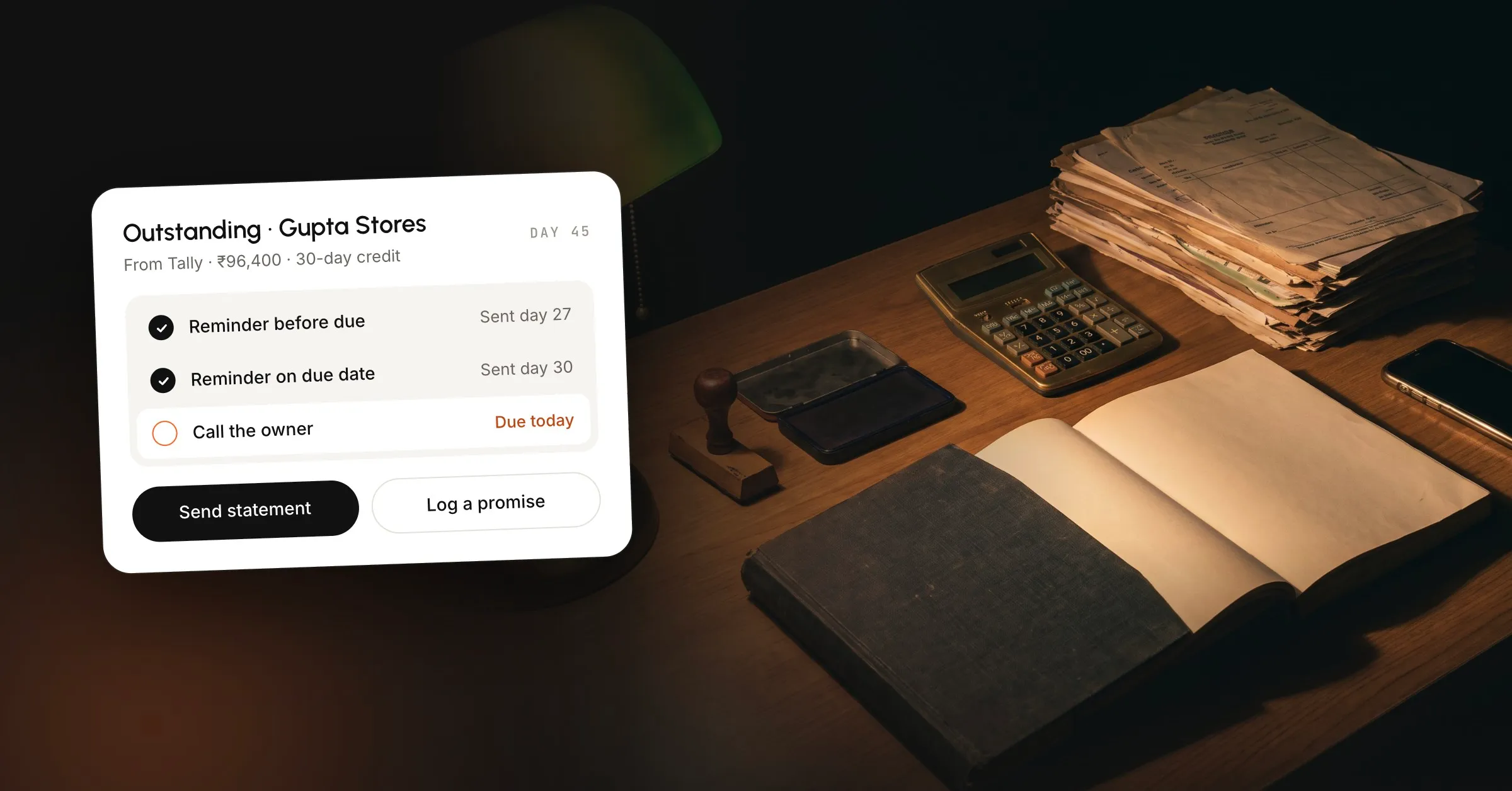
Payment reminder message on WhatsApp: a credit-days ladder
Payment reminder message on WhatsApp for distributors: credit days from Tally, Hindi templates, part-payments and the MSME 45-day rule.
TallyPrime WhatsApp integration sends the bill you already made. It will not read the dealer's order. Here is the path from that message to cash.

Nimish Gahlot
Founder, Empulse Labs
· Updated · 14 min read
Published
Updated · 14 min read
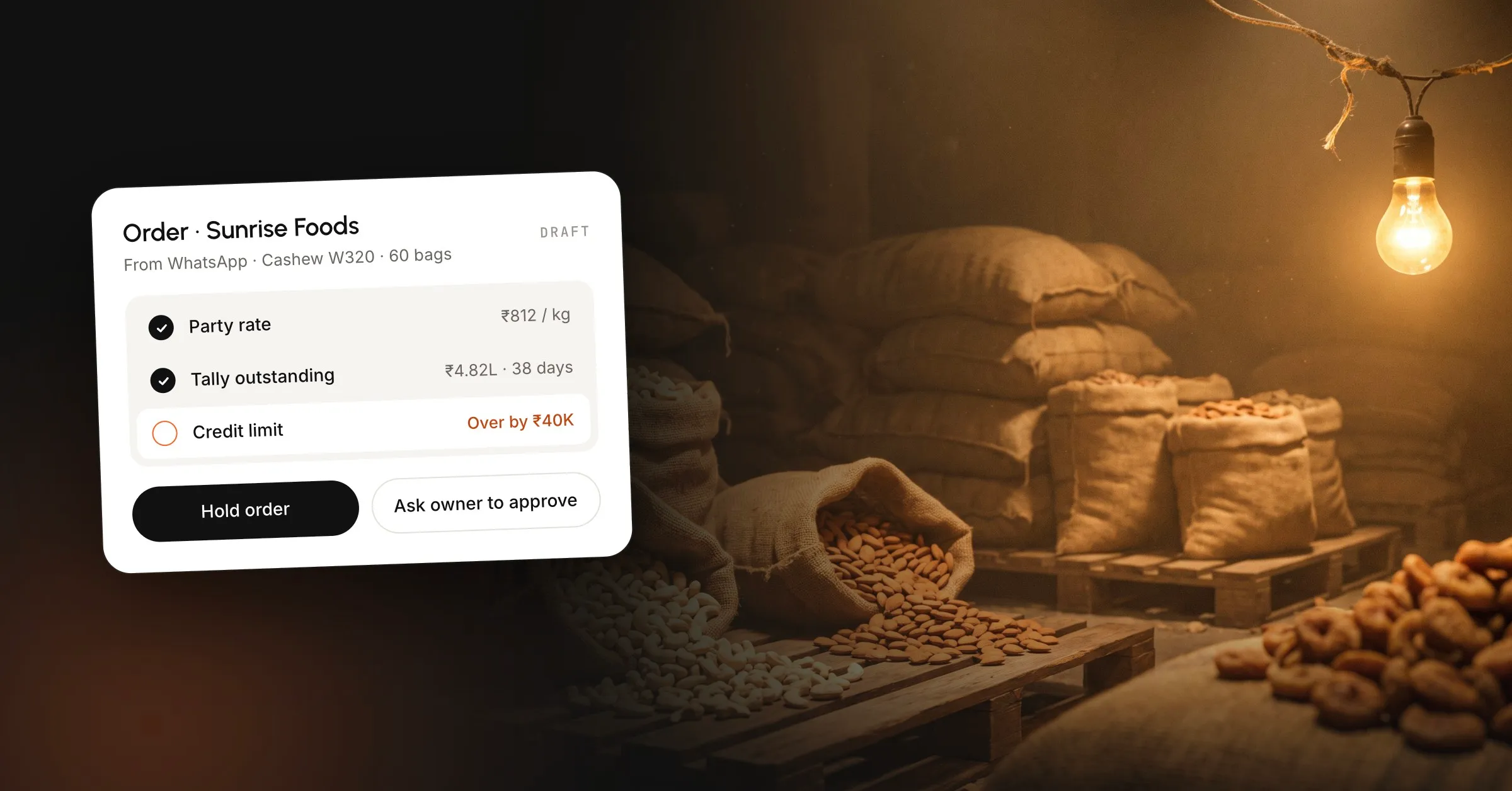
TallyPrime WhatsApp integration sends a document you have already made. Someone at the desk still has to read the dealer’s WhatsApp order, apply that party’s rate, and stop the bags when the ledger is over the limit. On an Indian trading desk the order arrives as a line, a voice note, a photo or a broker’s call, and someone still types it into Tally after the rush. From that message the desk has to reach a delivery order, a Tally invoice and a collected balance, and the order is typed once.
Tally Help describes the product in one direction. You onboard a WhatsApp Business number through Interakt, verify the business, activate a subscription, add that number inside TallyPrime, and then share documents on templates Meta has approved. Until a template is approved it does not appear in the list. You can design your own in the Interakt portal, submit it, and refresh.
The share itself is a keystroke on a voucher you have already saved. Tally’s document guide walks it like this:
A sales invoice that already carries a payment link or a QR can go on the payment-link template. The party taps Pay Now in the chat. Reminders start from Bills Receivable in Tally, on that same share. Set the report type to Reminder Letter, pick the ageing bucket, and send. The same share also covers dashboard tiles, all ledger accounts, and a confirmation of accounts.
Tally’s own intro on that page names the delivery note as the document the person on the vehicle needs. That note is a PDF of a voucher. A godown instruction still needs a marka, a vehicle number and a rule that it can be printed once, and the PDF has none of those.
The product page also talks about a dedicated inbox for replies, which a person has to read. The line “send 40 bags of W320 to the Panvel godown” stays a message until someone turns it into lines, a rate and a hold.
Some older tutorials still tell you to scan a QR code the way you link WhatsApp Web. The current Tally Help path is an Interakt account, a business number, and verification, so a guide that only shows the QR scan is out of date.
As of October 2026, Tally’s price list (last updated 3 July 2025) shows two different bills for India, Nepal and Bhutan. Both are exclusive of local tax.
| Pack | You pay | Wallet you get |
|---|---|---|
| Activation or renewal, per year | ₹1,300 | ₹100 |
| Top-up | ₹675 | ₹500 |
| Top-up | ₹2,700 | ₹2,000 |
Tally says the subscription runs a minimum of 12 months, and that yearly payment is what switches the feature on. The renewal adds ₹100 to the wallet. The wallet pays Meta, because Meta charges for the conversation. A ₹675 top-up credits the wallet with ₹500.
Before the number is on the WhatsApp Business account, Tally assigns a trial number for 5 days from the day the Interakt account is created.
Tally Help also states a daily limit the price card leaves off. An unverified business starts at 250 messages a day, and verification lifts that to unlimited. That figure is the sentence on Tally’s setup page. We have not re-checked it against Meta’s current tier ladder.
Partner sites sell a different product at a different price: a TDL that fires when you save the voucher and pushes the PDF out. That can be useful once the voucher exists, and the order still has to be typed before the TDL has anything to send.
Support for the official add-on sits with your Tally partner. The product page also lists support@tallysolutions.com and 1800 309 8859.
Pages that rank for this search describe the outbound PDF. On the wholesaler’s morning, the order is already late by the time a voucher exists to share.
The same morning can bring one order in five forms:
If those five do not land in one queue, they get typed at night, item names matched from memory, and a line gets missed. The clerk who knows that “W320” means this lot, in this godown, is the system. On the desks we sit with, that retype runs 4 to 5 minutes an order. When that clerk is out, the order waits or goes out wrong.
Voice notes, and orders written in Hindi or Hinglish, are how a lot of buyers write. We scope that on the first call, and we do not treat it as already live for every desk.
| Job | TallyPrime with WhatsApp | What the desk still needs |
|---|---|---|
| Order in | An inbox, if someone opens it | One draft, buyer’s words kept beside the item |
| Rate | Nothing. The voucher already has a price | Party rate, scheme, brokerage, before the truck |
| Credit | A warning. Enter still saves the order | A hold until a named person releases it |
| Dispatch | A delivery-note PDF, if you send it | Delivery order, marka, one print, vehicle |
| Invoice | The PDF, a payment link, a reminder | The bill the same day the goods leave, tied to that DO |
| Collection | A reminder letter from Bills Receivable | Paid, part paid, or hold, with the reason still visible |
Match your item codes first, then that party’s past orders, then AI for the rest. Anything unsure stays on the draft, with the buyer’s words beside the line, until a person confirms it, which is when the line becomes an order. A ship-to other than the usual godown stays open, and “Panvel” on a Vashi party is shown to the person confirming. A photo you cannot read stays a gap, with the SKU left blank.
New parties stay manual until the papers are in.
We ask for a GSTIN, or PAN and FSSAI, before a new party can be booked. Match that to your own list before you treat it as the rule for every state.
Run the credit check on the order before the bags move. The screen should show three figures from the party ledger: what they still owe, the credit days you agreed, and how long they usually take to pay. A party can be inside the days and over the limit, or inside the limit and late on an old bill.
Tally’s sales FAQ is blunt about what the software does on its own. You can record a sales order that exceeds the credit limit. A warning appears, and Enter still saves the order. The warning is only there if the party ledger has credit limits switched on, a limit entered, and the check for credit days during voucher entry. The receivables setup is where the limit and the default credit period are stored. Neither of those screens holds the order for a named person, so the hold is a rule you add, and the release should say who said yes.
The wrong rate is credit you did not mean to give. The goods go out at a price the party will not pay, and the argument starts after the vehicle has gone. Put the party’s rate, the scheme and the brokerage on the draft. Quote a buyer only their own rate, and leave the rate list out of the WhatsApp message.
The numbers below are the order on our wholesalers and traders screen, from a Mumbai dry-fruit and spice desk, and they record that order rather than a market rate.
The order is broker R. Mehta & Co. at 0.5 percent, buyer Sunrise Foods, cashew W320, lot KJ-07, 40 bags, 1,996 kg net at ₹160 a kg.
On that screen, market cess sits on the gross and GST sits on the net. If your firm does it the other way, the draft should follow your rule.
The same party’s ledger on that screen shows ₹4,82,300 due, and that they usually pay in 38 days. Both belong next to the total before anyone confirms. The stock card for W320 shows 420 bags, 60 booked and 360 sellable. Forty bags fits in the 360. If the lot is already oversold, booking it anyway is how a salesman promises bags the godown does not have.
Bag count and net kilos will not always divide into a clean bag. Bags dry, a bag gets split, and a sale can mix full bags with loose kilos. If the draft only stores one quantity, the godown guesses which bags to load.
An order inside the limit can still be the wrong lot, the wrong godown, or a party you have blacklisted. Raise the blacklist reason and wait for a person to decide whether this order is an exception.
The godown and the transporter execute the delivery order. Tally can WhatsApp a delivery note, and that note carries no marka.
A marka on the bags is how the godown tells one party’s lot from another’s. Require it before the order can be billed. Preview the delivery order, then print it once per user. On the Mumbai desk that rule is one print per delivery order per user, so one document cannot become two trips. That build took 9 working sessions and 5 logins, from the desk to the godown, and it is in daily use with launch testing still under way.
Buyer and broker both get the copy from your WhatsApp Business number, the one already saved on their phones. On the sample order the document is DO-2416, marka SF-12, vehicle MH 43 7781, and the Tally invoice number sits on the same row once it exists. Dispatch status hangs on that delivery order, including when the load is on the vehicle. Without that status, the office is the one tracking the load, and the “where is my order” calls keep coming.
The lot printed on the delivery order is the one that has to leave, because lot KJ-07 in Vashi is a different balance from the same grade in a cold store, or from a lot still on the road.
When the goods leave on Tuesday and the bill is made on Friday, the party’s credit days start late, or not at all, until someone remembers. Link the delivery order to its Tally invoice instead of keeping a second ledger to reconcile at month end.
Tally stays the books. We read parties, items and outstanding from it, and nothing is written back until a person approves. A draft can be wrong, and a voucher is harder to unwind, so the team checks the screen before it posts. Your accountant’s work stays the same. Sharing the PDF on WhatsApp is the last step, which is the send Tally’s add-on already does, after you create the invoice in Tally.
If your firm is inside the notified e-invoice bracket, pressing print leaves a B2B tax invoice unfinished. The invoice still has to be reported to an Invoice Registration Portal for an IRN and a QR code before the buyer can treat it as a valid tax invoice. Check whether you are enabled on the GST portal, and leave the books in Tally. A bill raised three days after the truck left is a credit-days problem, and for firms inside a reporting window it is a compliance problem too.
Goods moving by road often need an e-way bill once the consignment crosses the notified value. Put the vehicle number on the delivery order before the gate. If you add it in a WhatsApp message after the driver has called, the vehicle is already on the road.
Tally’s reminder letter sends the ageing you configured, from Bills Receivable, on your business number. A short payment, a TDS difference, or a promise to waive has to live on your own list, because the letter has no field for them.
Make the open balance a list with three states: paid in full, part paid, and hold with a reason. A TDS hold and a short payment both stay visible. A “paid” mark on a short bill is how the balance disappears.
A reminder can go to the party from your own number, and it should name the open bills. A threat to stop supply, a dispute, or a promise to waive waits for a person to send.
A party who breaks a weekly rhythm is a collections problem that has not shown up as a bill yet. They stop ordering without sending a complaint. You notice when a broker names a rival, or when the month looks light and nobody can say which buyer left.
Someone who orders every Monday and goes quiet for three weeks is a different case from someone who orders once a season. Show the gap, the last order, and what they still owe, on one list. On that same Mumbai screen, one party is 18 days quiet with ₹4.82 lakh open, another is 42 days quiet with ₹2.10 lakh open.
Draft the nudge and have a person send it. “Your usual is in” is enough. Keep a timer from messaging a buyer who is mid-dispute, or a party you have blacklisted, only because the quiet days ran out.
A quiet buyer owes you an order and a late payer owes you money, and one shared pile means both get ignored.
If the buyer says the bags were short, or the lot was mixed, a person works the dispute from the delivery order. Editing the stock in silence would hide what the buyer reported. A deletion needs a reason, after-hours locks stay on, and each login sees only its job, from the desk to the godown. A message that threatens supply, argues a rate, or waives money waits for a person even when the draft is ready.
Booking faster only helps if the rate, the stock and the buyer are the right ones. Once they are, send the invoice, the reminder and the payment link with the official WhatsApp add-on, after a person has entered the order.
This post covers what Tally’s own WhatsApp feature does. The wider order desk, from the dealer’s voice note to a confirmed order, is in WhatsApp order management for distributors, and the sequence for chasing unpaid invoices is in payment reminder messages on WhatsApp.
We build that path for dry fruit, spice, FMCG and commodity desks: one draft from the WhatsApp line to the Tally invoice, on your number, with you owning what we put in place. One workflow is live in 3 to 6 weeks, and the setup fee comes back if it does not work in 45 days. Most desks start with the order and the delivery order, then add stock, dues and the quiet-buyer nudge. If you also pack or process, your supplier retyping the purchase order is the same gap on the way in, and it sits on our manufacturing page. For the trading desk itself, start with wholesalers and traders, or look at the sales and operations systems we put on the tools you already run.
No. Tally's onboarding note says the green tick still goes through Facebook Business Manager, on the same process as before. Business verification for the API is a separate check. It is what raises the daily sending limit. A verified business is not the green badge on the chat, and paying the yearly pack does not apply for the badge.
Yes. On the share screen, Tally Help says you can pick Multiple Mobile Nos., add the numbers, then choose End of List. That is how a buyer and a broker can both receive the same bill. Each conversation still draws Meta's message charge from the wallet. A long list is not a free broadcast.
Tally's price list says the wallet carries forward when you renew. The renewal is what keeps the feature switched on, for a minimum of 12 months, and it adds ₹100 to the wallet. The top-up packs are separate, and they are how you pay Meta's per-conversation charge. A lapsed year stops the sending. It does not zero the balance you already bought.
Tally's onboarding offers two paths. Connect the number already on the WhatsApp Business app, or register a new one. Use the number saved on your parties' phones. A bill from a strange handset gets ignored, and a rate sent from a personal phone is how a list leaks. Do the move before the week you need invoices to go out.
No. WhatsApp sharing sends a document that already exists in Tally. It does not report the invoice to an Invoice Registration Portal, and it does not file the return. If your firm is in the notified e-invoice bracket, the IRN is a separate step inside Tally or on the GST portal. We do not take that filing over. The books stay yours.
Tally's onboarding page says that after three failed attempts Meta blocks the account. The retry then goes through Facebook Business Manager, not the same screen. A rejection usually means the legal name or the address you typed does not match the GST certificate. Finish that check before you ask the partner to place the yearly order, and do not leave it inside the 21 days after the number is onboarded.
Payment reminder message on WhatsApp for distributors: credit days from Tally, Hindi templates, part-payments and the MSME 45-day rule.
How a distributor turns a WhatsApp order into a Tally draft with that party's rate, a credit hold and stock by godown.
AI for MSME India pays back on Tally and WhatsApp desk jobs. Sensors and forecasts wait until the data exists. What to run first, and what not to buy.
Book a 30-minute call. We'll map the workflow costing you the most hours and tell you honestly whether AI can fix it.
Book a 30-min call