WhatsApp order management for distributors: from the message to Tally
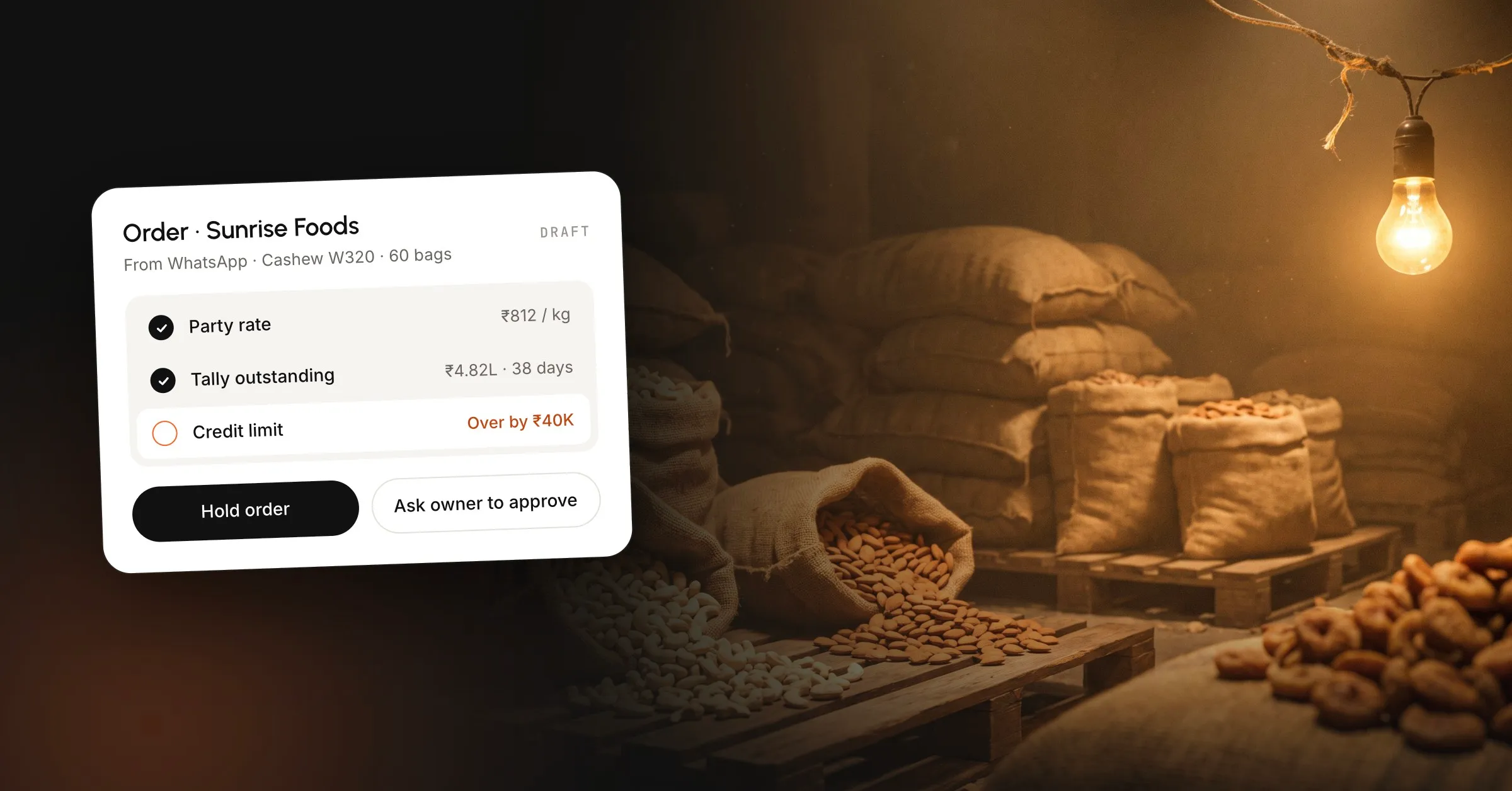
How a distributor turns a WhatsApp order into a Tally draft with that party's rate, a credit hold and stock by godown.
Payment reminder message on WhatsApp for distributors: credit days from Tally, Hindi templates, part-payments and the MSME 45-day rule.

Nimish Gahlot
Founder, Empulse Labs
· Updated · 14 min read
Published
Updated · 14 min read
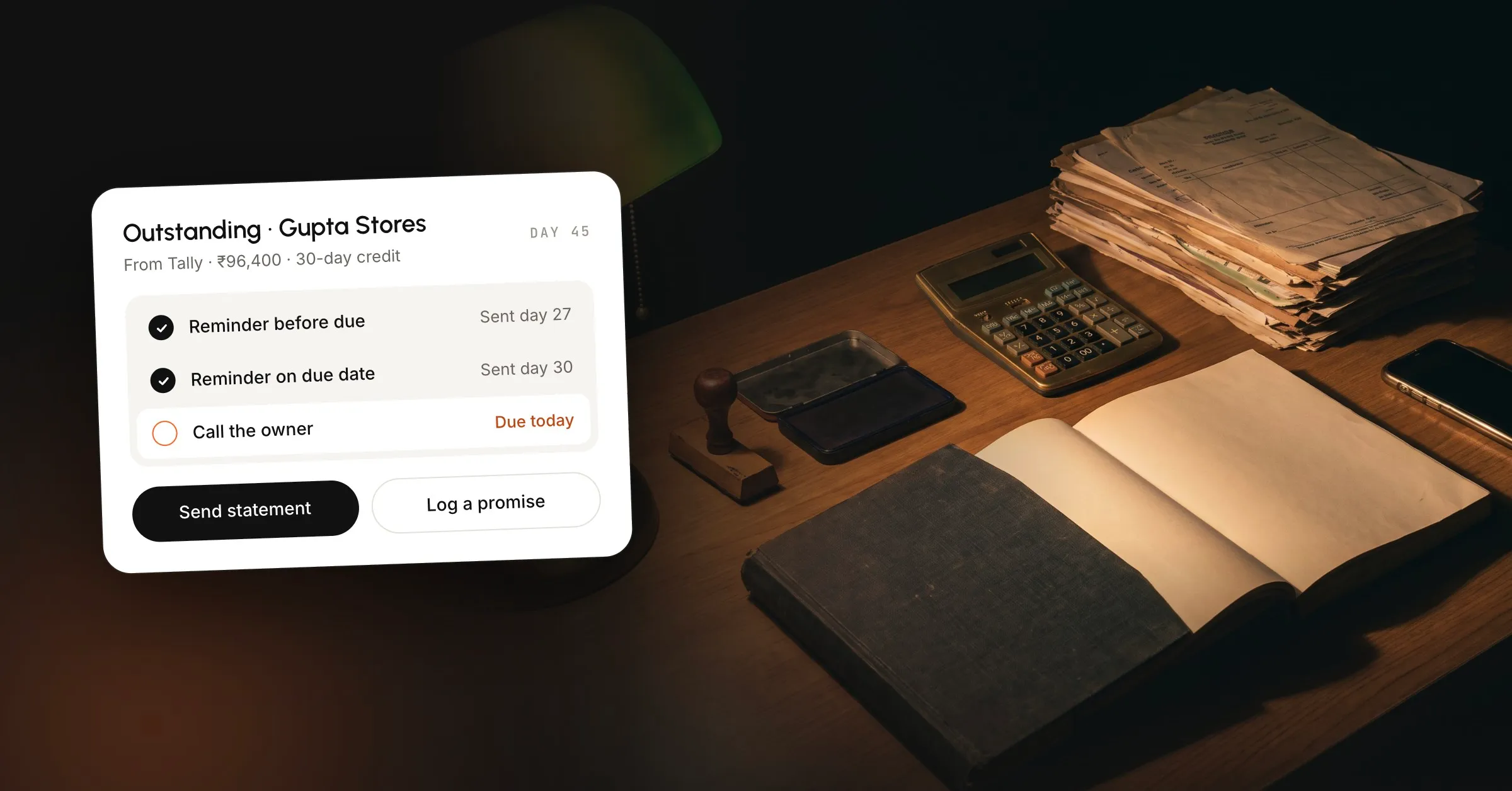
A payment reminder message on WhatsApp names the party, the open bills, the amount still due, and one way to pay, and it goes from the business number that party already has saved. Time it from the due date on the bill in Tally, the credit days you agreed. Send one message for the whole outstanding, and stop when they name a date or dispute a bill.
The party should be able to forward the message to their accounts person without calling you back. Put these six in the message:
Leave out a threat, a late fee you have not written into the terms, and any offer.
A template written for one invoice and a stranger with a pay link does not fit a distributor’s party, who orders every week, pays against several bills, and will argue a rate after the vehicle has gone.
Credit days are the term you agreed, outstanding is what the party still owes, and overdue days are how late a bill is. Ageing is the buckets those bills fall into. A party can be inside the limit and late on an old bill, or inside the days and over the limit, so follow the bills when you send the reminder and decide the limit when the next order comes in.
As of October 2026, Tally Help (updated 1 October 2026) puts the report at Gateway of Tally, then Display More Reports, Statements of Accounts, Outstandings, Receivables. Alt+G and Overdue Receivables shows only the overdue bills. Press F6 to age by bill date or by due date, and set the windows. Press F12 for the columns you want. Enter on a line opens the bill, and Enter again opens the voucher.
Age by due date when you are deciding who to message, because ageing by bill date makes a party on 30 days look late on the day you invoice them. Set the windows to the ladder you will actually send: not yet due, 1 to 7 days, 8 to 15, and over 15. A 0 to 30 slab hides the week in which a weekly retailer is still talking to you.
The Outstandings report is there only when bill-wise entry is on. Tally’s Q&A says to set Enable bill-wise entry to Yes under F11. Without it you have a ledger total and no bill number to put in the message. The due date on a bill comes from the credit days on that voucher or that party. A bill raised days after the goods left starts those days late. The path from the WhatsApp order to that bill, and the share that sends Tally’s own reminder letter, is the TallyPrime WhatsApp integration post.
On our wholesalers and traders screen, Sunrise Foods shows ₹4,82,300 due and pays in 38 days. Those 38 days are how long that party takes to pay, and the agreed term is the number you wrote on the bill. Suppose that term is 30 days. A bill that has already run 38 is 8 days past due, so it sits on the +7 rung, even when 38 feels normal for the account.
If the same house buys from you and sells to you, Tally shows one net balance, so chase the sales bills.
Tally’s reminder letter from Bills Receivable is the statement, for an ageing bucket you pick, on your business number. It has no field for “they said Friday”, a weight dispute, or a hold on the next order, so write those on your list beside the report.
Send on a working day, in working hours. Skip a Sunday night and a festival morning, and do not send two rungs on the same day.
| Step | When it goes | What changes |
|---|---|---|
| Before due | 3 days before the due date on the bill | Polite. Names the bills, the amount and the UPI id. |
| Due date | The due date | Asks for payment today, or a screenshot if it has gone. |
| +7 days | 7 days after the due date | Asks for a date. You write that date on the bill. |
| +15 days | 15 days after the due date | Says the next order waits. A person sends this. |
| Call | The next working morning, or the morning a promise date slips | No template. The person who knows the party calls. |
A retailer who lifts stock every week has often placed two more orders by day 30. The +15 message is the last written rung, and you call after that.
Skip a rung while a promise is open, while a bill is under query, or while this morning’s part payment is still unmatched. A missed promise moves that party to the call.
The amount in these lines is the ₹4,82,300 outstanding on Sunrise Foods on that same screen. Put the due date in from the bill, and use your own UPI id. We did not send these.
English:
Sunrise Foods, a reminder that bills totalling ₹4,82,300 fall due on [date]. The oldest are [bill numbers]. UPI: [your UPI id]. If you have already paid, send the screenshot and we will adjust it today. [Your firm]
Hindi, the way the desk actually writes:
Sunrise Foods, namaste. Aapka outstanding ₹4,82,300 hai, [date] ko due. Purane bills: [bill numbers]. UPI: [your UPI id]. Payment ho chuka ho to screenshot bhej dijiye, aaj adjust kar denge. [Your firm]
Sunrise Foods, ₹4,82,300 is due today against [bill numbers]. Please pay on the UPI id, or reply with the date the amount will leave your account. If it has gone, send the screenshot. [Your firm]
Sunrise Foods, aaj ₹4,82,300 due hai, bills [bill numbers]. UPI pe bhej dijiye, ya bata dijiye kis date ko payment niklega. Ho chuka ho to screenshot bhej den. [Your firm]
Sunrise Foods, ₹4,82,300 is 7 days past the due date on [bill numbers]. Please pay today, or reply with the date we should expect it. We will note that date on the bills. [Your firm]
Sunrise Foods, [bill numbers] par ₹4,82,300 due date se 7 din nikal chuke hain. Aaj pay kar dijiye, ya date bata dijiye. Wahi date bills par likh denge. [Your firm]
A person sends this, and they should write the hold only if they will hold the next order.
Sunrise Foods, ₹4,82,300 is 15 days past due on [bill numbers], and we do not have a payment date. The next order will wait until this is cleared or we have agreed a date. Call me if a bill is wrong. [Your name, your firm]
Sunrise Foods, [bill numbers] par ₹4,82,300 due date se 15 din se pending hai, aur koi payment date nahi mili. Agli order tab tak rukegi jab tak yeh clear na ho ya date fix na ho. Bill galat ho to call kar lijiye. [Your name]
These go in the same chat, the same day.
They name a date:
Noted. We have Friday, [date], against ₹4,82,300 on [bill numbers]. If that date moves, tell us before it does.
They say a bill is wrong:
Noted. We have kept [bill number] aside, and [name] will call you today. The other bills, if you agree them, can be paid on the same UPI id.
Say ₹2,00,000 of that ₹4,82,300 arrives, and it is adjusted to the oldest bills:
Received ₹2,00,000. Adjusted to [bill numbers]. Balance left on the account is ₹2,82,300. Thank you.
The ₹2,00,000 is an example split of that screen balance. We did not record a receipt for it. A thank-you that skips the balance reads as if the account is clear.
The WhatsApp Business app on the phone sends one chat at a time, to parties who already talk to that number. Use it when someone at the desk is already in those chats. It does not read a Tally due date, so it will not run the morning list.
A scheduled run uses the WhatsApp Business platform. Outside a live chat, you can send only a template Meta has approved. Meta’s service-message rules, updated 21 May 2026, start a 24-hour customer service window when the party messages or calls you. Inside it you can write a normal reply, and each new message from them resets the 24 hours. When that window closes, the next message has to be a template Meta has approved. The same page says you only message people who have opted in.
Meta’s template categories use two tests for utility. The message has to be non-promotional, with no promotional or persuasive intent, and it has to be specific to that user’s order, account, service or transaction, or be essential to them. Account alerts are the heading a due-payment reminder sits under. Meta’s example there is a reminder that a payment will be billed on a date, and the same section says not to promote, upsell, or include an offer.
A template that mixes the bill with an offer is marketing. A body that is only a blank is marketing too, because the content is unclear. Put the bill numbers and the amount in the template body. Each language, including Hindi, is submitted on its own, and it cannot be sent until Meta approves it. Tally’s share uses those approved templates. Onboarding, the wallet and which document the share attaches are in the integration post.
Meta’s opt-in guidance asks for permission that covers the kinds of messages you will send, or a separate permission per kind, and for an opt-out you actually honour. Orders on your business number are a relationship with that number. On the first order, record that they agreed to bills and payment messages there, and record the day they tell you to stop. Once they stop, call them.
A discount for paying this week fails the utility test. If someone offers it to one party, they do it inside the open 24-hour window, and the offer is written on the bill so the accountant sees it.
The receivables report clears a bill when the receipt is adjusted against that bill. An amount left on account leaves the bill looking unpaid, and the next rung asks for it again. Match the screenshot to the oldest agreed bill first, unless the party named one. A short payment stays open for the difference. A TDS cut you have accepted is a hold with a reason. Paid, part paid and hold are the three states on the list in the integration post, and the message you send has to match the state on that list.
Write the promised date on the bill the day they give it, and repeat that date in the chat. Ask for a calendar date. If that date passes with no receipt, call, and leave the polite note off the next send. Two slipped promises on the same party are a reason to hold the next order even before day 15.
Keep the dispute on the bill they named, whether the weight was short, the lot was mixed, or the rate was not the party rate. Take that bill off the ladder, name who will call, and keep asking for the other bills. Sending the +15 line while they are waiting on a credit note is how a good party stops reading the number that also takes their orders.
The message says the next order waits only after a named person has put that hold on, because Tally’s credit warning does not hold the order. A chat that announces the hold before that person has made it disagrees with the order desk.
As of October 2026, the clock runs against you when you buy from a micro or small supplier, and a retailer paying you late does not start that same clock in your favour.
Section 15 of the MSMED Act, 2006 says the buyer pays on or before the date agreed in writing, and that the agreed period shall not exceed forty-five days from the day of acceptance or deemed acceptance. With no written agreement, payment is due before the appointed day. Section 2(b) sets that day as the day after fifteen days from acceptance or deemed acceptance. Acceptance is the delivery day, unless the buyer objects in writing within fifteen days. Then it is the day that objection is removed. If nobody objects in writing in those fifteen days, the delivery day stands.
Section 16 makes a late buyer liable for compound interest with monthly rests, at three times the bank rate notified by the Reserve Bank, from the appointed day or from the day after the agreed date, notwithstanding any agreement. Section 23 keeps that interest out of an income-tax deduction. In section 2(n), a supplier is a micro or small enterprise that has filed the memorandum, so a medium supplier falls outside this chapter. A reference to the Facilitation Council under section 18 belongs in a filing, so keep it out of the reminder.
When you are the buyer, a micro or small manufacturer starts that clock on acceptance. Tally’s MSME payables report, updated 29 September 2026, filters Sundry Creditors to micro and small parties and can show bills due in the next few days or already overdue. The due date follows the credit days on the invoice, or the credit days allowed for micro and small parties under F11. The page also notes interest at three times the RBI bank rate, and that an MSME can take a delayed bill to MSME Samadhaan. Run it so a supplier bill does not cross the written date while the desk is chasing retailers.
When your firm only trades, the Ministry of MSME’s office memorandum of 1 September 2021 says benefits to retail and wholesale trade are restricted to priority sector lending, and that the delayed-payment provisions are excluded. As of October 2026, the RBI master direction on lending to MSMEs still describes that trade as MSME for priority sector lending only. What you can enforce against a retailer is the term you wrote down and a hold on the next order. Udyam on a trading firm does not, by itself, add a 45-day right on top of that. Do not put “MSME Act” in a WhatsApp message to a kirana unless someone has checked that this supply sits inside section 15. This is not legal advice.
The system can read the due date, fill the amount, and stop when a date or a dispute is already on the bill. A waiver, a threat, or a decision to keep supplying a late party anyway stays with a person.
| Step | The system does | A person does |
|---|---|---|
| Before due, and the due date | Sends, if nothing is on hold and no promise is open | Writes it themselves when a dispute is open |
| +7 days | Sends the ask for a date | Writes the date they were given, and the reply |
| +15 days | Drafts the hold line | Sends it, and holds the next order |
| A promise date that slips | Raises a call task for the morning | Makes the call |
| A waiver, a fee, or a rate argument | Does not send | The person who can decide |
Build the stop rules before the schedule. Once those stops hold, the before-due and due-date lines can go on their own.
We put this ladder on the Tally outstanding and on the WhatsApp number the party already uses, for dry fruit, spice, FMCG and commodity desks, and you own what we put in place. One workflow is live in 3 to 6 weeks, and the setup fee comes back if it does not work in 45 days. Most desks start with the order and the delivery order, on the wholesalers and traders page, and add the reminder once bills are bill-wise. The wider set of sales and operations systems stays on the tools you already run.
Send it from the firm's WhatsApp Business number, the one already saved on the party's phone. A personal chat has no approved template and no record the desk can open later, and a rate typed there is how a list leaks. The Business app is enough for one party at a time. A scheduled run across the outstanding needs the WhatsApp Business platform and a template Meta has approved.
Send one message for the open balance, with the total and the oldest two or three bill numbers. A party with many bills will mute a number that pings once per invoice. If the list is long, attach the outstanding statement and keep the chat line short. Pull a disputed bill out of that total so the bills they accept can still be paid.
Ask for the screenshot or the UTR the same day, and match it to a bill before anyone marks the balance paid. An amount left on account still shows the bill as open, so the next reminder asks for money already in. If the screenshot is short, record a part payment and leave the rest on the ladder. Stop messages on that bill while you match it.
A discount is promotional. Meta treats a template that mixes an account update with an offer as marketing, a different category from a utility reminder. Keep the template to the bills, the amount and how to pay. An early-payment cut, if you offer one, is a decision a person sends in the open chat, and it has to be written on the bill.
On the WhatsApp Business platform, each language is submitted and approved on its own. English copy does not cover a Hindi send. Write the Hindi version the way the desk speaks, with the same placeholders for the party, the amount, the due date and the UPI id. Until Meta approves that template, it will not appear for sends outside the 24-hour window.
With credit limits switched on, Tally shows a warning, and Enter still saves the sales order. The hold is a rule you add, and a named person releases it. That warning and the release are in the TallyPrime WhatsApp integration post. A reminder that says the next order will wait is only honest if that person will actually wait.
How a distributor turns a WhatsApp order into a Tally draft with that party's rate, a credit hold and stock by godown.
TallyPrime WhatsApp integration sends the bill you already made. It will not read the dealer's order. Here is the path from that message to cash.
AI for MSME India pays back on Tally and WhatsApp desk jobs. Sensors and forecasts wait until the data exists. What to run first, and what not to buy.
Book a 30-minute call. We'll map the workflow costing you the most hours and tell you honestly whether AI can fix it.
Book a 30-min call