GST on second hand mobiles: margin, exchange and buyback
Dealers pay GST on the margin of a used phone when Rule 32(5) fits. Exchange, buyback, the invoice line and the Tally entry, with the rules linked.
What A, B and C mean on a used phone, with a grading sheet and a rupee buyback you approve before paying.

Nimish Gahlot
Founder, Empulse Labs
· Updated · 14 min read
Published
Updated · 14 min read
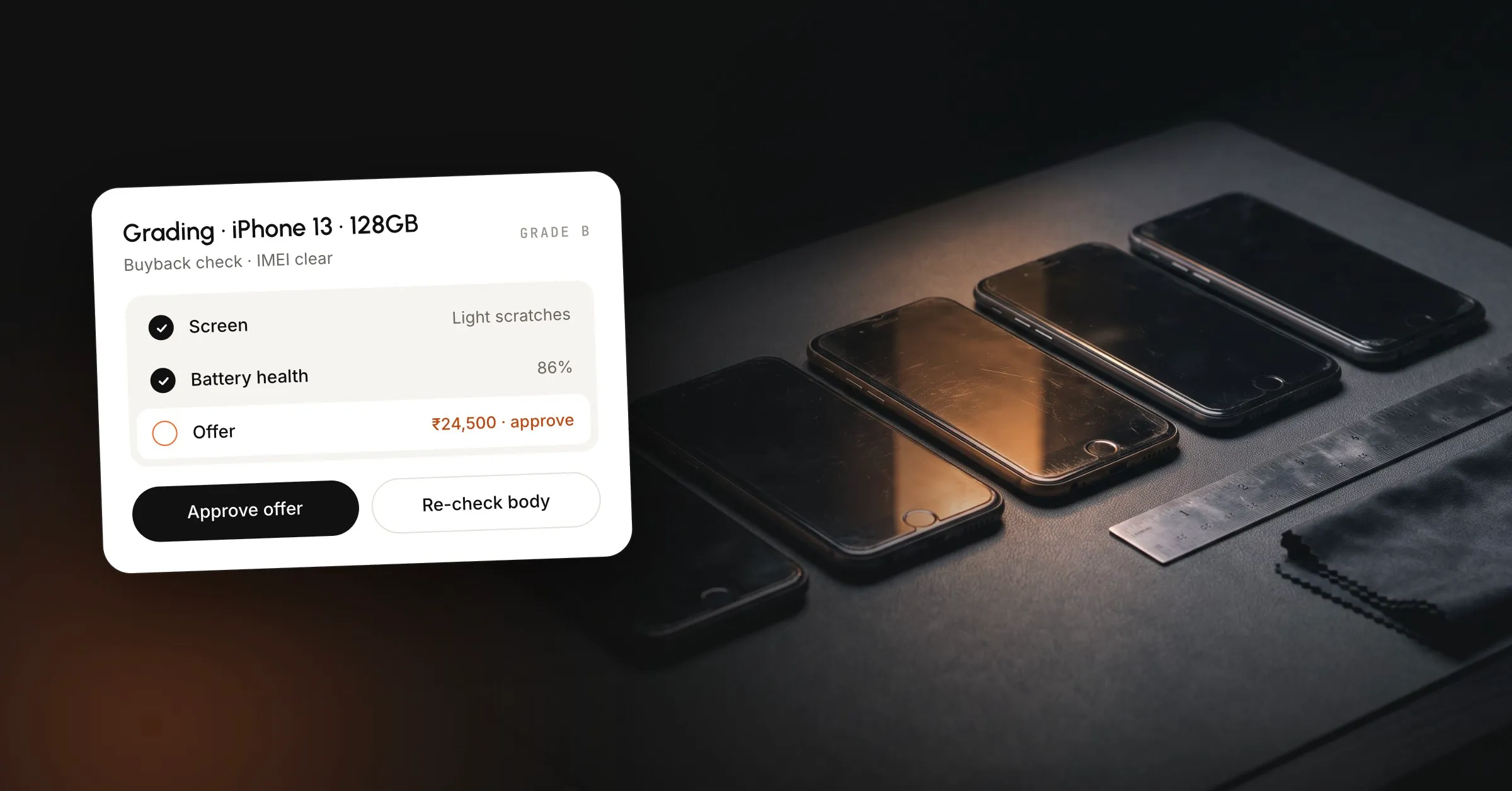
Refurbished phone grades are letters for defects you can see and measure: the screen, the body, and the battery percentage, with a separate pass or fail for whether the phone works. India has no government scale that defines A, B or C. Grade B, the letter people look up, is light wear on a phone that still works, with the battery percentage written on the sheet. A cracked display sits on the stop row. The buyback is the resale you expect for that letter, minus parts, a reserve for returns, and the margin you mean to keep. A person approves the figure before cash moves.
A mobile phone grading system is a cosmetic label. Shops, Cashify and the overseas marketplaces do not share one definition, and we did not find a BIS or MeitY scale that assigns A, B or C. Cashify’s grading guide says the grades describe “how the phone looks on the outside,” so the letter names the glass and the frame. Battery health, a SIM that registers, a signed-out iCloud or Google account, and a clean IMEI sit on their own rows. Fold those into the letter and two staff can pay two prices for one phone.
The sheet below is what we want both shifts to use on the same handset. Cashify and Amazon publish their own names in the table after this one. This sheet is the procedure our counter uses to write the letter, and the letter carries no certificate.
Hold the phone under the counter light and look at the screen switched off, then switched on. Run a fingernail across any mark. If the nail stops in the groove, the scratch is deep, and if the nail glides, it is a hairline. Stand the phone about 30 centimetres away for the body, which is the distance Amazon Renewed’s India help uses. Then read the battery figure the phone itself shows.
| Check | Grade A | Grade B | Grade C | No letter |
|---|---|---|---|---|
| Screen | Nothing visible with the display off, at arm’s length | Marks with the display off, none that show as a line with it on | A nail catches. The glass is not cracked through | Cracked glass, or it will not power on |
| Body | No marks at 30 cm, no dent | Scuffs at arm’s length, one dent the nail misses | Several dents or corner rash | Bent frame |
| Battery | iPhone 90% or above. Android: write the reading shown | iPhone 80% to 89%, or a battery priced on its own line | iPhone under 80%, priced before it is called ready | No reading, because it will not switch on |
| Works | Display, touch, cameras, sound, charging, biometrics, SIM | Same list, or only the battery already on the offer | Powers on, touch and SIM pass. Any other fault is priced | Account lock, SIM fails, or the IMEI does not match |
A hairline that shows only when you tilt the glass can stay an A if the nail does not catch it. The 90% iPhone floor is the one Amazon Renewed Premium and Back Market’s Premium row both publish. Android phones do not share one percentage screen, so write the number or the word the handset shows. A screen that says “Good” stays “Good”, because 87% would be a figure you invented. Every functional row passes, and the previous owner is signed out. A panel you can pick by the colour of the glass or the thickness of the bezel is out of A even when the scratches would have passed.
Refurbished phone grade B is light wear with the phone still working. A chip in the camera glass, a bent corner, or any crack leaves B. On an iPhone, 80% to 89% stays on the sheet as a battery fact: price the resale for that band, or fit a battery and subtract the part. The glass can stay a B when the offer already carries that part. An 83% you hoped the buyer would not notice comes back as a return you then have to honour.
Amazon’s India Excellent and Good grades both want an unscratched screen. A B with scratches visible on a dark screen misses their Good, and on Back Market those same scratches are Fair.
Grade C still powers on, answers to touch, and registers a SIM. A bent frame leaves the letter blank and goes to repair or a parts price, because straightening a frame is a different job from a polish.
An iPhone under 80% waits for the battery line before anyone calls it ready. Apple’s battery article says iPhone 14 and earlier batteries are designed to retain 80% at 500 complete charge cycles under ideal conditions, and iPhone 15 and later at 1,000 cycles. Amazon Renewed India, and the later paragraph on Back Market’s help page, both use 80% as a floor for phones they list. A dead speaker, camera or one-sided charge port can stay a C when the fault is written down and priced. Leave that fault inside the letter and the next person sells a phone that cannot do the job the listing described.
Leave the letter blank when any of these is true.
*#06# does not match the sticker, or the genuineness check names a different brand.Price them as a repair, as parts, or as a refusal, because a cracked screen marked as a polite C comes back the following week.
As of October 2026, a Delhi or Mumbai counter meets three public scales: Cashify, Amazon Renewed India, and Back Market. Each publishes its own names, and those names disagree with our A, B and C and with each other.
| Our letter | Cashify | Amazon Renewed India | Back Market, phones |
|---|---|---|---|
| A | Superb: cleanest look, body wear hard to see at about 20 cm. No battery percentage published | Premium: no screen scratches, body clean at 30 cm, battery over 90%, one-year brand warranty | Premium: almost no wear, genuine parts, battery at least 90% |
| B | Good: more visible use than Superb. Read that listing | Excellent and Good: unscratched screen, battery over 80%. Good allows light body marks at 30 cm | Excellent and Good: unscratched screen. Body marks hide past about 8 inches (Excellent) or 20 inches (Good) |
| C | Fair is the worn grade. Best Value is a fourth label | No Acceptable grade on the India page. A scratched screen misses all three | Fair: body scratches and dents, light screen scratches with the device on, still called fully functional |
| No letter | A dead or locked phone is not Best Value | All three grades say fully functional | Every grade is sold as 100% functional |
Cashify’s Superb is their cleanest look. Our A also wants the 90% iPhone battery, a signed-out account, and a panel that does not look replaced. Read those off the unit before you pay a Superb price to resell it.
Back Market’s help page carried a modification date of 9 October 2026 when we read it. The Premium row asks for genuine manufacturer parts and a battery of at least 90%. Further down, the same article says every battery is guaranteed at least 80% of original capacity, and that original parts are not guaranteed. Record the grade you are actually listing, and keep the 90% paragraph and the later 80% paragraph as two rules. The help page names Premium, Excellent, Good and Fair. Some US write-ups still add Very Good.
Amazon.com adds a fourth condition, Acceptable, which allows shallow screen scratches. The Amazon.in page we read stops at Good, and Good still says the screen has no scratches. An India listing copied from a US Acceptable photo misses the India definitions.
Run the rows in one order. The battery gets skipped when someone jumps to the letter because the customer is waiting.
*#06# and match every IMEI to the sticker and the box. A dual-SIM phone shows two, so keep both, then run the genuineness check below before you talk price.Those photos are what you still have when the seller says the scratch was not there.
Dial *#06# on the phone in your hand. Sanchar Saathi, the Department of Telecommunications portal, tells users to read the IMEI that way, and its FAQ describes an SMS, KYM and the 15 digits, to 14422.
The CEIR mobile user manual, version 03, is the department’s own steps. Chapter 3 says the SMS, the app and the web portal are how a buyer checks before paying. On the manual we read in October 2026, a valid device comes back with the device details, a blocked device comes back as blocked, and an invalid IMEI comes back as invalid. If the brand is not the phone you are holding, or the message says blocked or invalid, do not pay.
A valid result still leaves open a theft nobody has reported, because blocking is the user’s own request. The manual asks for a police complaint, identity proof, and a reissued SIM for the one-time password. The purchase invoice is optional. Status of that request needs the request ID. A phone that will not register on a SIM, with no explanation you believe, does not get a working-phone price.
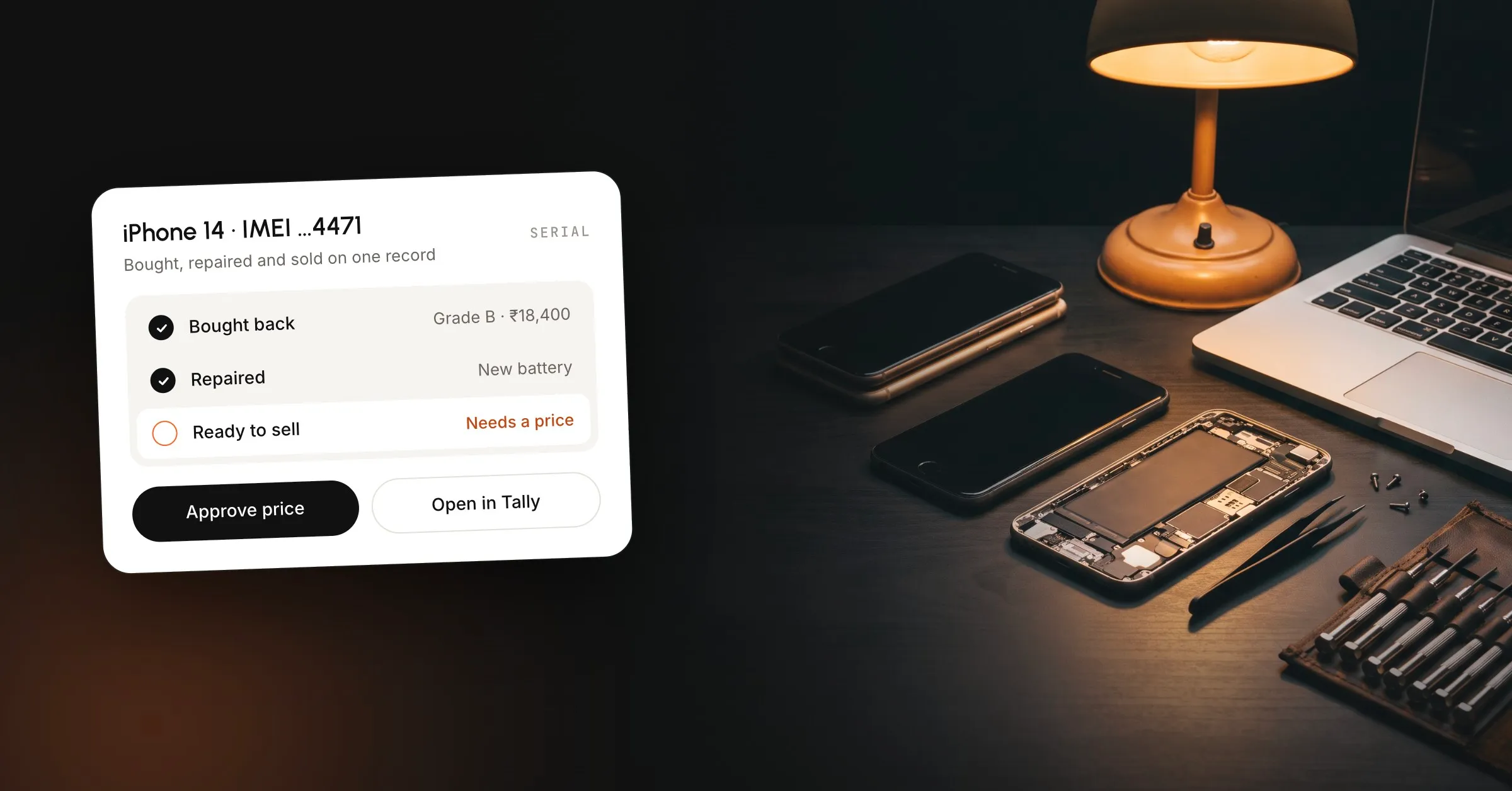
Recording the 15 digits comes after this pay decision. In Tally Prime the IMEI is a batch of one, and the grade, the photos and this offer sit beside that batch. The clicks, the second IMEI, and what to do when the buyer returns the phone a week later are in how to add an IMEI number in Tally Prime.
The letter sets the resale band you start from. Two grade B phones of the same model still differ by a battery, a missing bill, and the warranty you are about to give. Subtract, in order, the parts you will fit, a reserve for returns inside that warranty (your shop’s rate, since we cannot hand you one), a holdback when the seller has no bill, and the margin you mean to keep. A person then pays that figure, cuts it, or refuses the phone.
These rupees are a worksheet. We have not measured them at a shop. On our phone and laptop dealers page the device work is a Mumbai Apple sales, service and rental partner: one coordinator between every job and its engineer, three surfaces, and a goal of 24 minutes down to 3 per task. That build is scoped, the result is not in, and none of those figures is a buyback price.
| Line | Amount |
|---|---|
| Expected resale if this grade B holds, your counter | ₹24,000 |
| Battery you will fit | ₹1,800 |
| Cable you put in the box | ₹200 |
| Reserve for returns inside the warranty you give | ₹800 |
| Holdback, walk-in seller, no bill | ₹500 |
| Margin you want before the tax line below | ₹3,500 |
| Offer a person may pay | ₹17,200 |
₹24,000 minus ₹1,800 minus ₹200 minus ₹800 minus ₹500 minus ₹3,500 is ₹17,200. Change the top line when your last sale of this model was different, since the ₹24,000 in this table is only a sample.
The glass is cracked, so the part is a screen at ₹4,800 in place of the battery at ₹1,800, and the phone has left grade B. If you had already paid ₹17,200, then fitted the screen and the cable, and then met the GST illustration below, the cash left against a ₹24,000 resale would be ₹24,000 minus ₹17,200 minus ₹4,800 minus ₹200 minus ₹1,224, which is ₹576. That ₹576 does not fund the ₹800 returns reserve. The seller already has the ₹17,200, so the next cracked phone is refused at a B price on the stop row for a cracked panel.
If a new panel also means you can no longer ask ₹24,000, redo the resale line before you redo the offer. A replaced screen often moves the listing from Premium or Superb down to a lower grade.
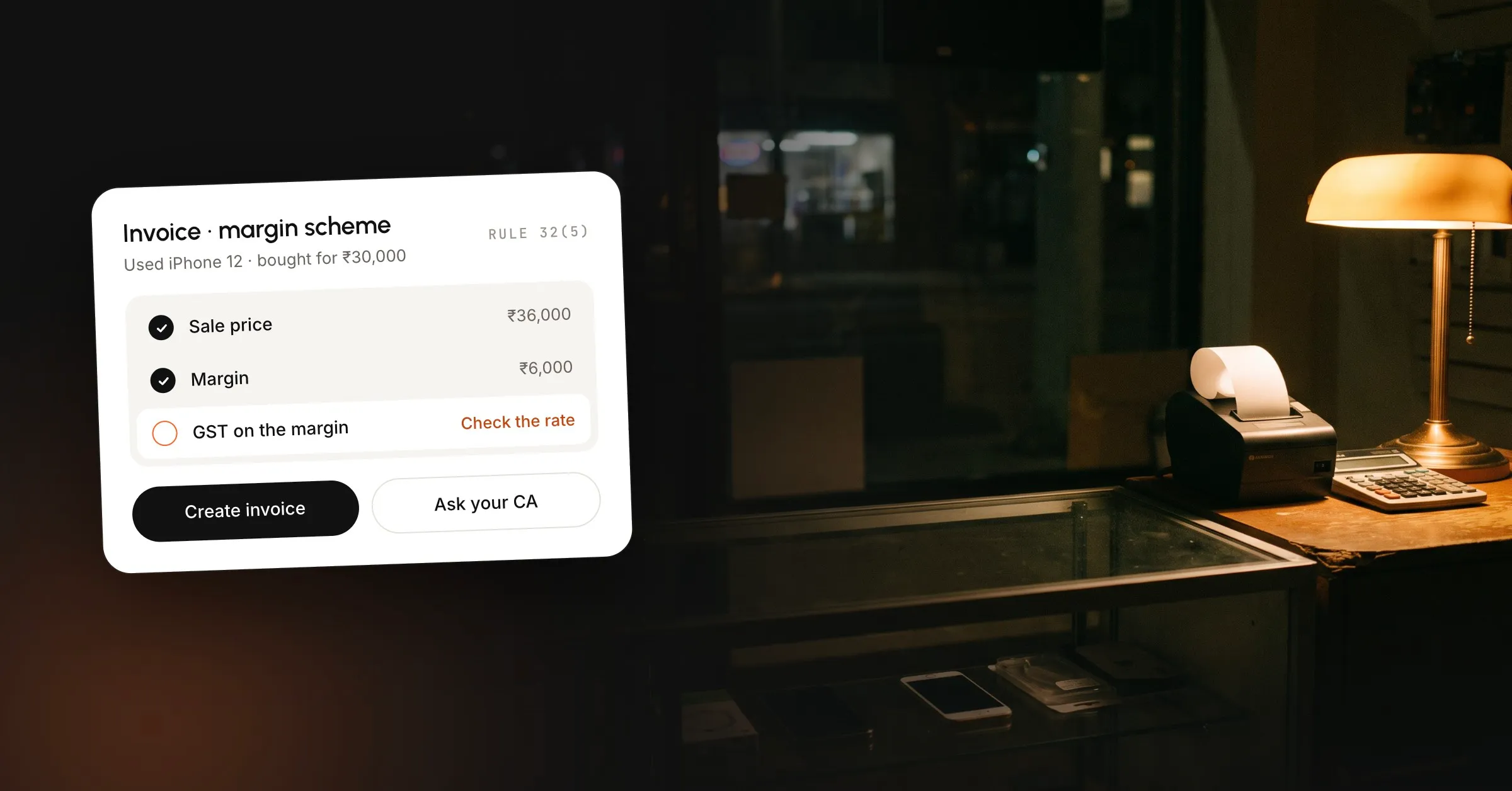
Rule 32(5) of the CGST Rules is an option for a dealer in second-hand goods. The value may be the difference between the selling price and the purchase price, where the goods are used as they are or after “minor processing which does not change the nature of the goods”, and where no input tax credit has been taken on that purchase. Where the supplier uses the option, the rate applies to that difference. A negative difference is ignored. Sub-rule (1) says the supplier chooses this method.
Heading 8517, which covers telephones for cellular networks, sits in Schedule II of Notification No. 9/2025-Integrated Tax (Rate), dated 17 September 2025, and that schedule is the 18% IGST schedule. Serial 490 of the schedule is “8517, All goods”. The parallel central-tax notification of the same date, No. 9/2025-Central Tax (Rate), taxes its Schedule II at 9% CGST. Intra-state, CGST and SGST together are 18% when the state notification matches, which is the rate in the illustration. Your invoice still follows the notification that applies to the supply.
If ₹24,000 and ₹17,200 are the selling price and the purchase price in the rule, the difference is ₹6,800 and GST at 18% is ₹1,224. The ₹3,500 margin then leaves ₹2,276, because the ₹17,200 offer was calculated before that tax.
If the ₹3,500 has to remain after that GST, the offer has to fall by more than ₹1,224, because a lower purchase price widens the difference the tax is charged on. Parts and reserves here are ₹3,300. You need 82% of the difference to cover ₹3,300 plus ₹3,500, so the difference is ₹6,800 divided by 0.82, which is ₹8,293 to the nearest rupee. The offer becomes ₹15,707. GST at 18% of ₹8,293 is ₹1,493. Then ₹8,293 minus ₹3,300 minus ₹1,493 is ₹3,500.
The sums above are arithmetic on this reading of the rule. If the invoice shows GST on top, or both prices already include tax, the rupees change. Credit on a battery from a registered dealer is a different invoice from credit on the handset, and a full panel swap may sit outside minor processing. Ask your CA before the offer assumes the margin scheme, since we are not your CA.
A photo model that scores scratches can help two staff agree on the glass. The same model misses a finance lock, a SIM that fails, and the rupee left to subtract, so the payment waits for a person. We store the checks your shop defined. A diagnostics bench is outside that work, and so is certifying a data wipe to a laboratory standard. A channel that wants a wipe certificate needs the lab that issues it.
Write the Android battery screen the phone actually shows. A case left on hides the corner that should have changed the letter. A grade copied from a US Acceptable listing, or from a Kogan page, belongs to that shop’s scale.
If this sheet is still a notebook that two people fill differently, put that notebook on the counter first. It runs on the tools you already use, for sales and operations, and you own what we put in. A first workflow is live in 3 to 6 weeks. If it does not earn its place, the setup fee comes back within 45 days. The shape of the work is on what we build.
How good a refurbished phone is depends on the checks written next to the letter. Grade B on this sheet is light wear, a working phone, and a battery percentage written down. A listing that never states battery health, replaced parts or who honours the warranty is only a cosmetic claim. Use the checklist and the price sum for the buy or the buyback.
Cashify sells Superb, Good, Fair and Best Value, and its guide says those words describe how the phone looks. Superb is the clean cosmetic end. Our grade A also wants a 90% iPhone battery, which Cashify does not publish. Read the listing's condition line before you treat Superb as a match for A.
The Amazon.in Renewed help page we read in October 2026 lists Premium, Excellent and Good. All three say the phone is fully functional and the screen has no scratches. The US page also has Acceptable, which allows shallow screen scratches. Leave that fourth grade off an India listing, because a scratched screen misses the India definitions as written.
On iPhone 15 or later, open Settings, tap Battery, then Battery Health. On iPhone 11, 12, 13 or 14, tap Battery Health & Charging. Write down maximum capacity. Apple says iPhone 14 and earlier batteries are designed to hold 80% at 500 cycles, and iPhone 15 and later at 1,000, under ideal conditions. Price the phone from the percentage on the screen.
Indian autocomplete for refurbished phone grades suggests Kogan alongside Amazon. Kogan is an Australian retailer, and its letters are that retailer's own scale, separate from Cashify's labels and from the A, B and C sheet in this article. If a customer quotes a Kogan grade, ask which scratch and which battery percentage they mean, then grade the handset in front of you.
Take the case and the tempered glass off before you mark the screen and the body. A protector hides a scratch a nail would catch, and a cover hides a dented corner. Photograph the phone bare, then the case if it is part of the deal. The letter comes from the bare handset, and putting the case back on leaves the row as you marked it.
Dealers pay GST on the margin of a used phone when Rule 32(5) fits. Exchange, buyback, the invoice line and the Tally entry, with the rules linked.
Add each used phone's IMEI in Tally Prime as a batch of one, then keep the grade, the repair and the resale on that same number.
AI for MSME India pays back on Tally and WhatsApp desk jobs. Sensors and forecasts wait until the data exists. What to run first, and what not to buy.
Book a 30-minute call. We'll map the workflow costing you the most hours and tell you honestly whether AI can fix it.
Book a 30-min call