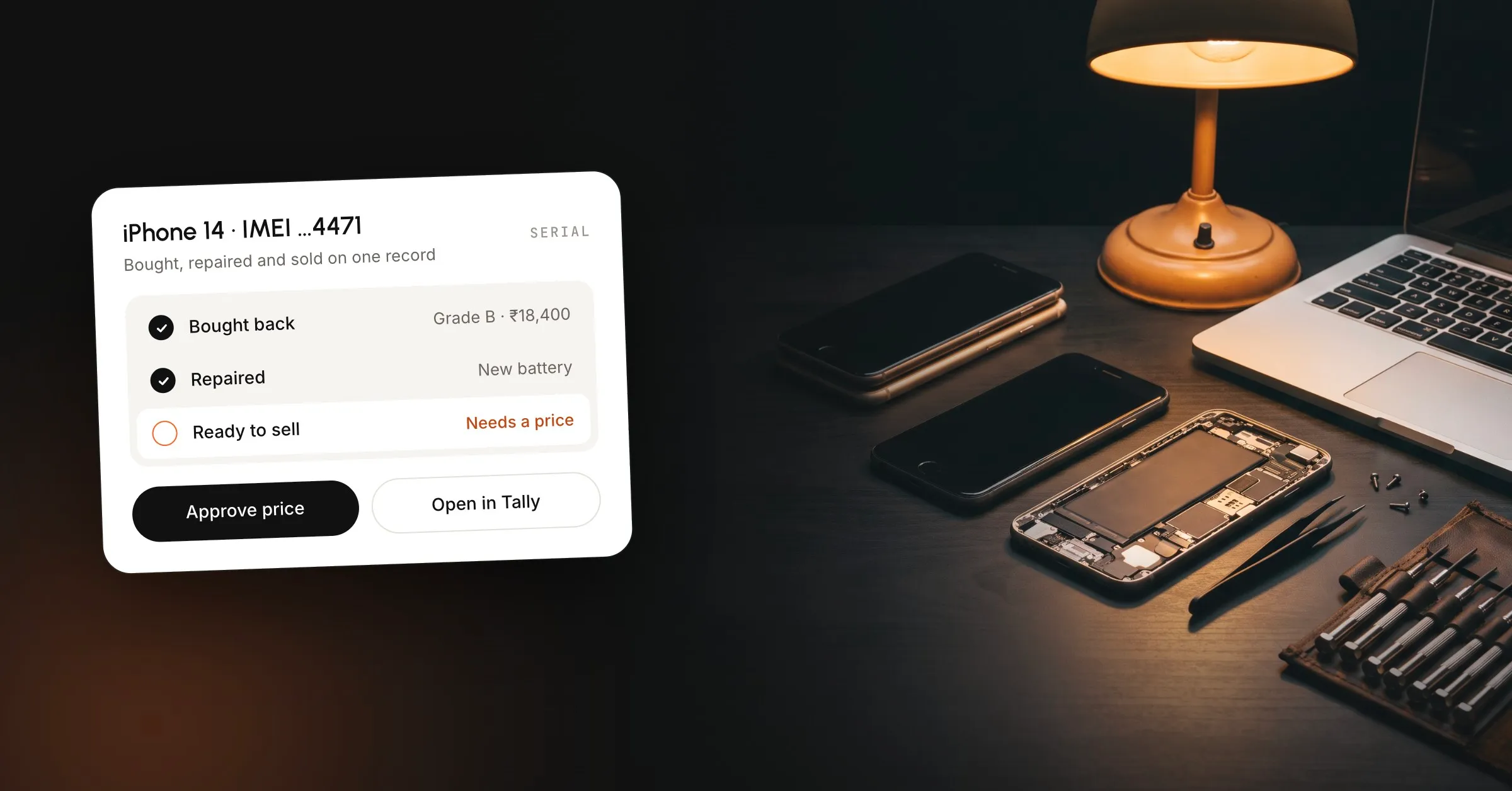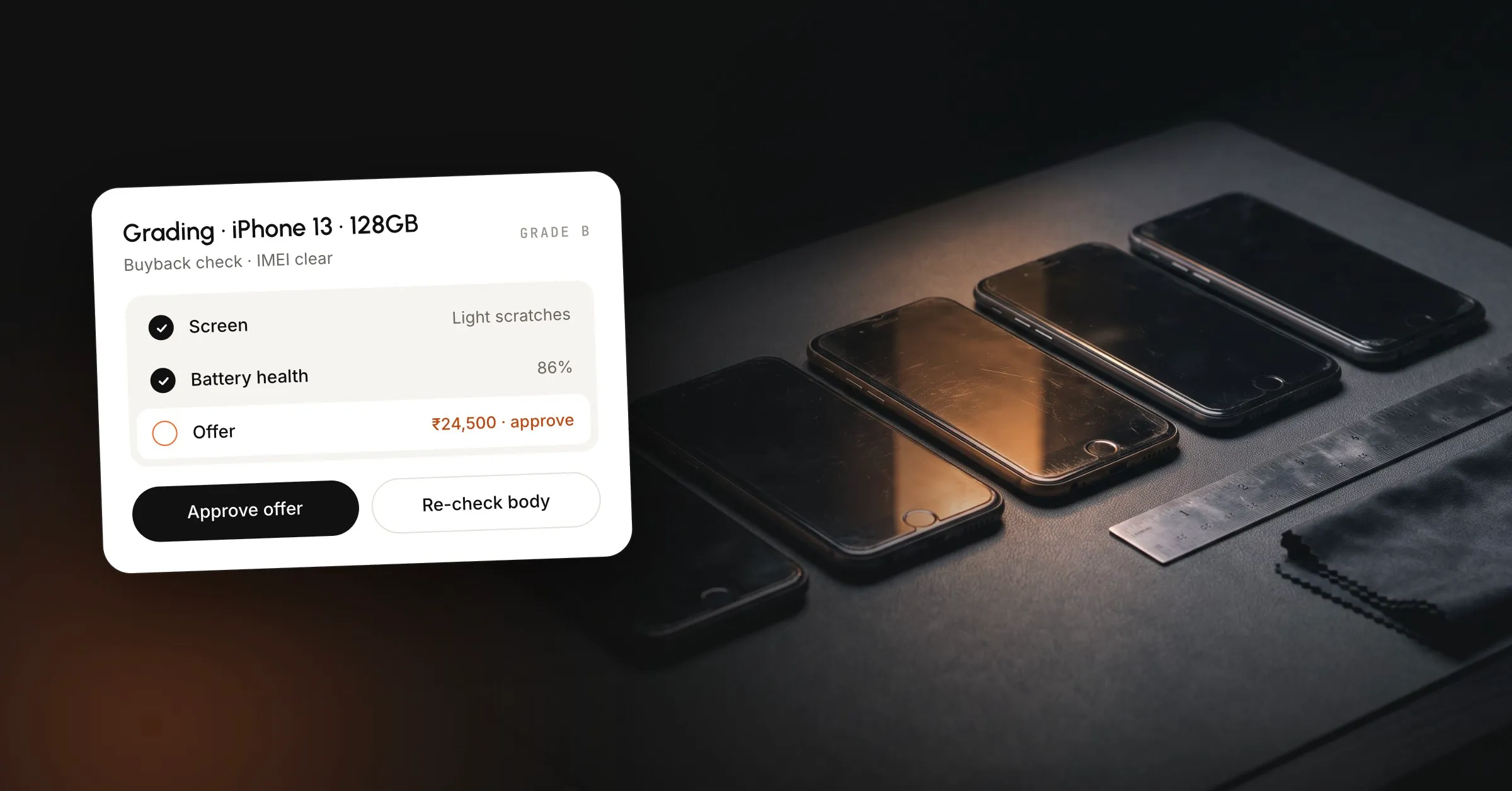
Refurbished phone grades: A, B and C, and the buyback price
What A, B and C mean on a used phone, with a grading sheet and a rupee buyback you approve before paying.
Dealers pay GST on the margin of a used phone when Rule 32(5) fits. Exchange, buyback, the invoice line and the Tally entry, with the rules linked.

Nimish Gahlot
Founder, Empulse Labs
· Updated · 15 min read
Published
Updated · 15 min read
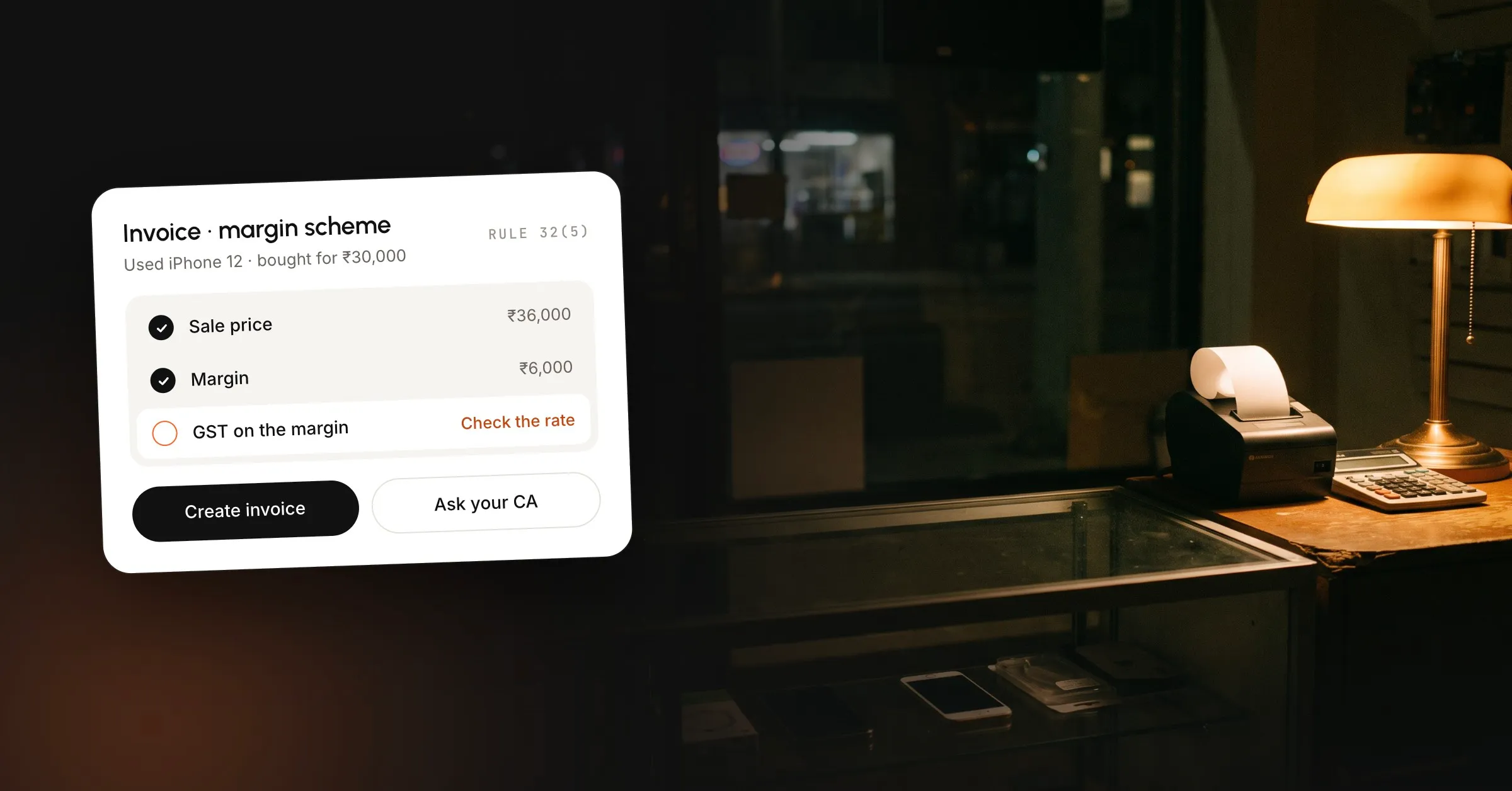
GST on second hand mobiles is charged on the margin when a dealer buys a used phone and sells it under rule 32(5) of the CGST Rules: selling price minus purchase price, and a negative result is ignored. The handset is taxed at the rate for its heading, the same rate a new phone under that heading uses. A cash buyback is a purchase today and a taxed margin when the phone is sold. An exchange is valued under rule 27 at the open market price of the new phone, so the cash the customer hands over is only part of the consideration. Ask the CA who signs the return before the invoice format changes, since this page is not tax advice.
The rupee lines are worked examples we calculated for this page, and we have not measured them in a shop.
Yes, GST applies when a registered dealer sells one in the course of business. The same GSTIN covers new stock and used stock. Tax on the used phone is worked out on the margin, and tax on new stock is worked out on the price.
Rule 32(5) applies to a taxable supply by a person dealing in buying and selling of second-hand goods. The goods have to be used goods, sold as such or after minor processing that does not change their nature, and no input tax credit may have been taken on that purchase. Sub-rule (1) puts this value at the option of the supplier, so the same GSTIN can sell new phones on the ordinary value and used phones on the margin.
The GST Council flyer on the margin scheme, updated November 2022 and still the flyer on the Council site when we read it in October 2026, traces the scheme to goods that already bore tax when they first entered the chain.
A used phone is taxed at the rate for its heading. As of October 2026, Notification No. 9/2025-Central Tax (Rate), dated 17 September 2025, supersedes the 2017 central rate notification and comes into force on 22 September 2025. The PIB note of 18 September 2025 is the page that names that notification for the central rates on goods.
In the schedule we read, heading 8517, “All goods,” sits in Schedule II at 9% central tax. On an intra-state bill the state tax matches it, so the customer sees 9% and 9%. On a sale to another state the voucher uses the integrated-tax ledger. The concessional margin rate notified for certain used motor vehicles applies to those vehicles. A handset is billed under heading 8517 at the central rate above.
A charger, a glass or a cable on its own line follows its own heading, and that line is taxed apart from the phone’s margin.
| Deal | Value the tax uses |
|---|---|
| New phone, cash is the only consideration | Price paid, under section 15 |
| New phone, old phone taken in exchange | Open market value of the new phone, rule 27 |
| Used phone, no credit taken on its purchase | Selling price minus purchase price |
| Used phone, credit taken on its purchase | Full selling price |
| Used phone sold below the purchase price | Ignored on that phone |
All four conditions in the sub-rule have to be true for that phone.
Rule 32(1) makes the margin optional. The Gujarat Authority for Advance Ruling, order GUJ/GAAR/2025/05 dated 23 March 2025 (Jitendra Equipment), held that the applicant could use rule 32(5) on a second-hand line and keep ordinary valuation on its existing trade, including margin on unregistered purchases and full-price tax with credit on registered purchases. Section 103 binds that applicant and the officers on that case, so the order illustrates the option in sub-rule (1) for that applicant.
The Council flyer’s car illustration takes a ₹3 lakh purchase and a ₹3.5 lakh sale as a value of ₹50,000, and says GST shall be levied on that difference. Applied to a phone, the same difference is the value in this table.
| Line | Amount |
|---|---|
| Purchase price, cash paid for the phone | ₹15,000 |
| Selling price | ₹19,000 |
| Value under rule 32(5) | ₹4,000 |
| Central tax at 9% | ₹360 |
| State tax at 9% | ₹360 |
| GST on this sale | ₹720 |
Added on top of a ₹19,000 selling price, the customer pays ₹19,720. Tax on the full ₹19,000 would be ₹3,420 at the same 18%.
Work each handset on its own, because a month of purchases and sales rolled into two totals hides a loss inside another phone’s profit. The rule ignores a negative value on the supply that produced it.
Rule 35 extracts tax where the value of supply already includes it: inclusive value times the rate, divided by 100 plus the rate. Treat the ₹4,000 margin as already including 18% and the tax is ₹4,000 × 18 / 118, which is ₹610.17, on a taxable value of ₹3,389.83.
Rule 32(5) calls the difference the value, and the flyer levies tax on it. Divide by 118 only where the CA agrees the selling price already contains the tax. Until then the voucher follows the first table.
The flyer puts repair, refurbishing and reconditioning into the margin. The rule defines the value as selling price minus purchase price, with no line that adds the parts bill to the price you paid the customer.
A ₹1,800 battery on the phone above leaves the purchase price at ₹15,000 and the value at ₹4,000, with the battery cost inside that ₹4,000. Writing the purchase price as ₹16,800 would shrink the value to ₹2,200. The sub-rule’s purchase price is the price paid for the phone, so the battery stays out of it.
The same Gujarat order held, for that applicant, that purchase price excludes repair cost, and that the applicant could not take credit on the repair while using rule 32(5). The credit holding reaches past “the purchase of such goods,” because a battery is a purchase of a part. It binds that applicant, and parts credit for any other shop stays a question for the CA. Flag the battery bill for the CA, and leave the repair cost out of the purchase price in the meantime.
Buy a handset for ₹16,000 and sell it for ₹14,500. The difference is negative, so the rule ignores it, the tax on that supply is nil, and the ₹1,500 trading loss stays in the books. The ₹1,500 does not reduce the ₹720 on the phone that cleared ₹4,000.
Most buybacks come from a customer with no GSTIN. The purchase carries no tax, so there is no credit on that phone, which is the condition rule 32(5) needs.
Section 9(4), after the amendment in force from 1 February 2019, lets the government notify a class of registered persons who pay tax on specified supplies from an unregistered supplier. The class named in the public notes we read is the promoter class in the construction notification, and a phone shop is outside that class.
Notification No. 10/2017-Central Tax (Rate), dated 28 June 2017, still exempts an intra-state supply of second-hand goods from an unregistered person to a registered dealer who pays central tax on the outward supply at the rule 32(5) value. The Council flyer cites it. It was written when section 9(4) was a general charge, and it has not been withdrawn. On the text we read in October 2026, a walk-in buyback is an exempt purchase under that notification, with the tax on the later outward supply at the rule 32(5) value. A later notification that named dealers under section 9(4) would bring reverse charge back onto that purchase.
Buy that phone from a registered dealer and the choice is on the purchase voucher, while the invoice is in front of you. Take the credit, and the resale is taxed on the full selling price, because rule 32(5) then fails. Leave the credit, and the margin stays available. If the choice is reconstructed at month end, the same phone can carry both the credit and the margin, and we would not save that bill.
A customer who pays ₹20,000 and hands over an old phone has given consideration that is partly a phone. Section 15 uses the transaction value only where the price is the sole consideration and the parties are not related.
Rule 27 values a supply where the consideration is not wholly in money, starting with the open market value. The rule’s own illustration is a phone supplied for twenty thousand rupees along with an old phone, where the price without the exchange is twenty-four thousand rupees, so the open market value is twenty-four thousand rupees. That definition of open market value excludes the tax.
| Line on the new phone | Amount |
|---|---|
| Cash the customer pays | ₹20,000 |
| Price of that phone with no exchange | ₹24,000 |
| Value under rule 27 | ₹24,000 |
| Central tax at 9% | ₹2,160 |
| State tax at 9% | ₹2,160 |
| GST on the new phone | ₹4,320 |
Tax on the ₹20,000 cash would be ₹3,600 at the same rate, ₹720 below the illustration. A bill that treats the exchange allowance as a discount undercharges by that gap on every exchange.
The old phone still enters stock at the gap between the no-exchange price and the cash, which is ₹4,000, and that is the purchase price we would book so a later rule 32(5) sale has a figure to subtract. Sell it for ₹7,000 and the value is ₹3,000, GST ₹540 at 9% plus 9%. Book the allowance as a flat discount with a zero cost, and the later margin is the whole ₹7,000.
A price cut with no old phone coming in can stay out of the value under section 15(3), when it is recorded on the invoice at the time of supply. An exchange puts a second good on the counter, and the taxable value is the one written on the voucher that was saved.
A buyback for cash, with no new phone going out, is a purchase of used goods. Rule 27 applies when the consideration is partly a handset. The outward supply, and the tax, happen when this phone is sold.
The amount you pay is a commercial sum: expected resale, minus the repair you can already see, minus the margin you want. A person approves the payment, and that approved sum is the purchase price in the later GST working. The offer, the grade and the approval stay on the unit record, and the money moves once that approval is given.
If the buyback and the new-phone sale happen in one visit, split them on the bill. One line is the new phone at the rule 27 value. The other is the purchase of the old phone, with no output tax. A single net figure leaves out the ₹720 that the split charges on the exchange gap.
No separate invoice format has been notified for the margin scheme. The tax invoice still shows the description, the heading, the taxable value, the rate and the tax. On this sale the taxable value is the margin, ₹4,000 in the example. Heading 8517 goes on the line. The narration on the voucher is:
“Value of supply determined under rule 32(5) of the CGST Rules, 2017. Input tax credit has not been availed on the purchase of these goods.”
The purchase price stays on the purchase voucher and the unit record. A customer who can see a ₹19,000 tag and a ₹4,000 taxable value can subtract one from the other and recover the purchase price, so that price can stay off the customer’s copy. The return includes that taxable value in outward taxable supplies. We have not found a Council instruction to park the purchase price on a 0% line and the margin on an 18% line, so the voucher keeps a single taxable value, the margin.
The supply stays in the taxable column, taxed on the margin, and the return lists the line as a taxable supply, which is separate from nil-rated and from exempt.
Tally’s help, on the page updated 29 January 2026, has no margin-scheme voucher for Indian GST, so the path is to override the taxable value. The Gulf VAT screen that mentions a profit margin is a different tax. An Indian phone is posted through the taxable-value override on the sales voucher.
On the sales voucher, in item-invoice mode, follow Tally’s override steps:
The buyback sits on a purchase voucher with no GST ledger when the seller is unregistered and no reverse charge is due. The rate is the purchase price. The batch name is the IMEI, quantity 1, which is the stock method in how to add an IMEI number in Tally Prime.
Rule 32(5) subtracts the purchase price from the selling price. A purchase voucher with no rate, or a sale that picks up a different 15-digit string, leaves the invoice margin as a number the counter remembered. Grade, photos and the seller’s name stay on the unit record beside the batch. The taxable value on the sales voucher is the margin those records support.
On our phone and laptop dealers page, that unit record follows the handset into Tally. The override above happens after a person has looked at the purchase price, the selling price and the difference.
Skip rule 32(5) on a phone where any one of these is true.
A person still approves the voucher. We can show the purchase rate, the selling rate and the difference on one screen. Whether a repair was minor, and the filing of the return, stay with the CA and with the person who posts.
If the margin cannot be tied to one IMEI, fix that record before you automate the bill. We build that lane on the Tally you already keep and on your own WhatsApp number, for sales and operations, and you own what we put in. One system is live in 3 to 6 weeks. If it does not work in 45 days, the setup fee comes back. What we build sets out that engagement. Bring one buyback and the sales voucher that followed it, and we will trace the purchase price through to the taxable value.
Rule 32(5) stops the dealer from taking credit on the purchase of that phone. The words do not withdraw credit for a registered customer who receives a tax invoice and meets the usual conditions in section 16. We have not found a clause that cancels the customer's credit only because the seller used the margin. The customer's CA has to accept the invoice before anyone books the credit.
A one-off sale of a personal phone sits outside the margin scheme, which is for a person dealing in buying and selling used goods. GST reaches a supply made in the course or furtherance of business. Someone who buys handsets to resell is in that business even before the registration threshold. A person clearing one phone out of a drawer is not running that trade.
Rule 32(5) values used goods the dealer bought and is selling. A screen or battery fitted to a phone the customer still owns is a repair, billed on the parts heading and the labour heading at their own rates. The margin sum starts only once the shop has bought that handset and later sells it. Keep the job card off the used-phone stock item.
The proviso to rule 32(5) covers goods repossessed from an unregistered defaulting borrower. The purchase price is deemed to be the price that borrower paid, reduced by five percentage points for every quarter or part of a quarter from that purchase to the disposal. A walk-in buyback does not use this cut. A lender should have its CA apply the proviso.
We found no exemption that switches e-invoice or e-way bill off because the taxable value is a margin. The Gujarat Authority for Advance Ruling, in GUJ/GAAR/2025/05 dated 23 March 2025, declined to answer an e-invoice question because it sat outside section 97(2). Treat the normal thresholds as still applying, and put the margin in the taxable value. Confirm the current turnover cut-off with the CA before a large bill.
Rule 32(5) is for a person dealing in buying and selling the goods. A counter that never takes ownership, and is paid a commission for matching a seller with a buyer, is supplying a service. GST falls on that commission at the rate for the service. Book the commission in its own ledger so it stays off the handset stock item.
What A, B and C mean on a used phone, with a grading sheet and a rupee buyback you approve before paying.
Add each used phone's IMEI in Tally Prime as a batch of one, then keep the grade, the repair and the resale on that same number.
AI for MSME India pays back on Tally and WhatsApp desk jobs. Sensors and forecasts wait until the data exists. What to run first, and what not to buy.
Book a 30-minute call. We'll map the workflow costing you the most hours and tell you honestly whether AI can fix it.
Book a 30-min call