GST on second hand mobiles: margin, exchange and buyback
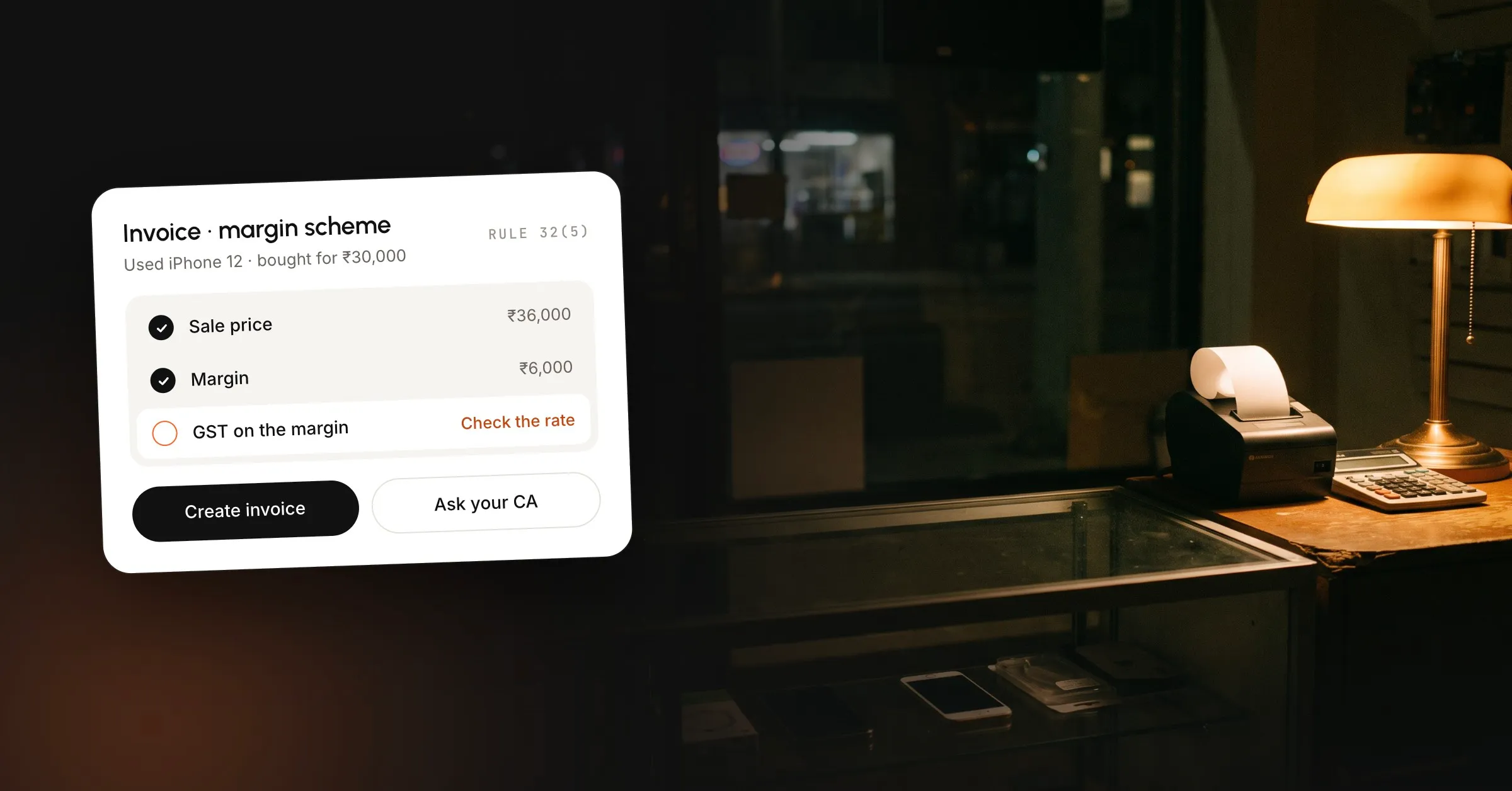
Dealers pay GST on the margin of a used phone when Rule 32(5) fits. Exchange, buyback, the invoice line and the Tally entry, with the rules linked.
Add each used phone's IMEI in Tally Prime as a batch of one, then keep the grade, the repair and the resale on that same number.

Nimish Gahlot
Founder, Empulse Labs
· Updated · 14 min read
Published
Updated · 14 min read
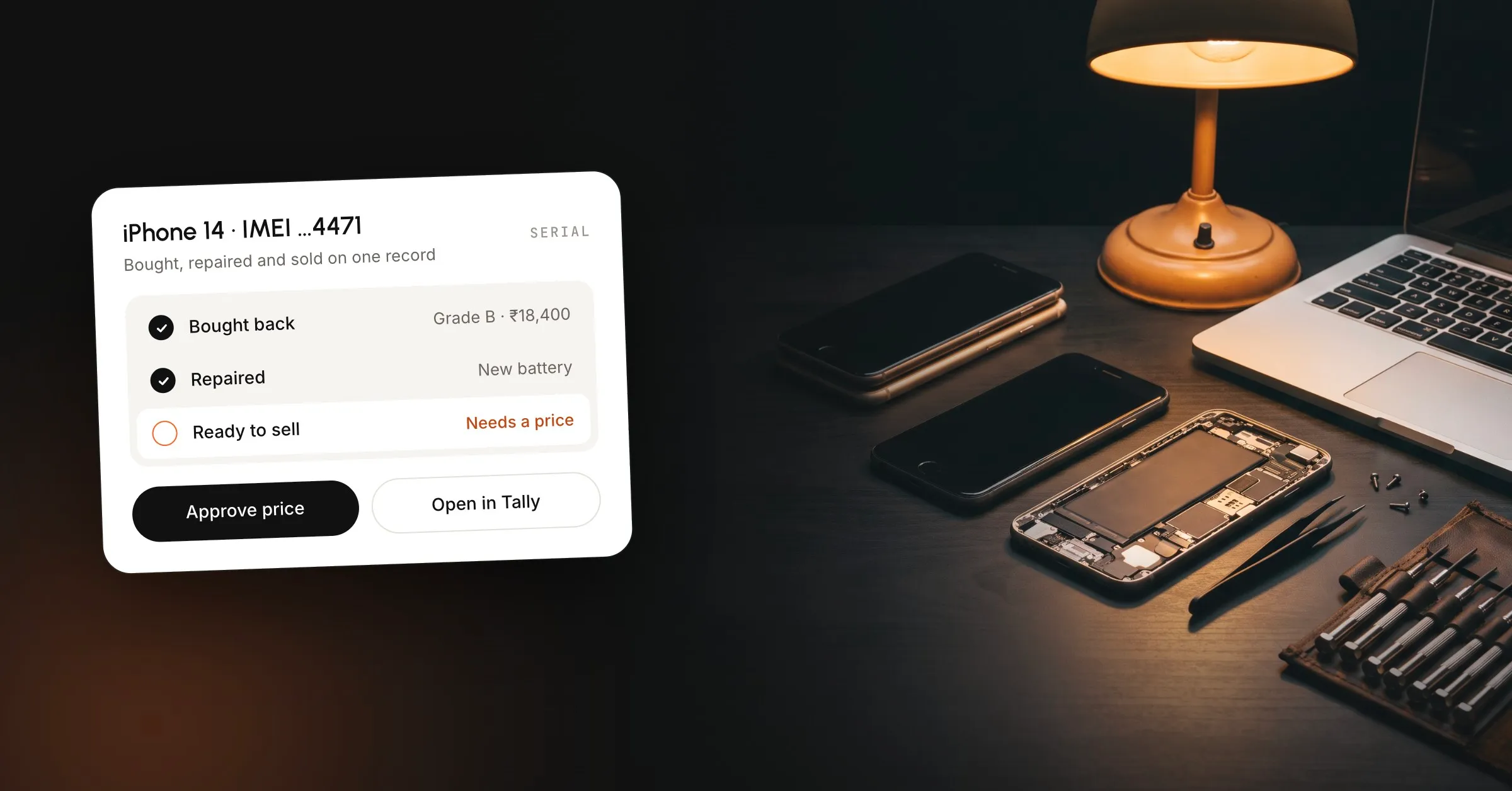
To add an IMEI number in Tally Prime, turn batches on for the company, set that stock item to maintain batches, and type the 15-digit IMEI as the batch name with quantity 1. Tally’s own help uses a mobile phone this way: one unit, one batch. The entry tells you whether the phone is still in stock or already sold. The grade, what the repair cost, and whether the offer still leaves a margin sit on a record beside that batch.
TallyPrime keeps an IMEI in a batch, a field built for a lot that shares a date or a cost, and a used phone is a lot of one. As of October 2026, Tally’s batch setup is still enable-batches, then the stock item. The older Tally.ERP 9 note on unsold mobiles is the page that names the phone. In Tally’s words, “each unit of a mobile phone can consist of its IMEI number.” Use the TallyPrime clicks below. The ERP 9 menu names have moved.
Tally’s older note allows a lot prefix, a month plus the digits. Skip that prefix so the number on the box, on *#06#, and on the invoice stays one string, since a prefix would record the phone under a second identity.
The 15th digit is a check digit. GSMA’s IMEI rules define 15 digits: an 8-digit type allocation code, a 6-digit serial, and that check digit. GSMA’s line is that the IMEI “uniquely identifies an individual mobile device.” Fourteen digits in the batch and fifteen on the phone means two units on paper.
On a purchase, select the party, the purchase ledger and the stock item. Tally’s purchase-with-batches steps are: pick a batch or type a new number, enter quantity and rate, then Ctrl+A. A buyback often has no brand-distributor ledger. Use the walk-in party you already keep, and put the seller’s name on the unit record beside the batch.
On a sale, pick the same item and the same batch so quantity 1 leaves it. The sale should list batches you already bought. A blank box lets someone type 15 new digits and save a batch the purchase never had.
Print the batch on the invoice if the sales format has a batch column, so the customer and the warranty desk can read the number. Treat that column as a choice for the desk, and do not read it as a GST rule that the tax invoice must show an IMEI.
Tally’s batch reports are the stock check. Batch Summary shows quantity, rate and value. Batch Vouchers lists the inward and outward documents. On the older unsold-stock example, a sold phone has a blank closing quantity and a phone still in stock shows 1.
That stops “sold twice” and “we cannot find what we paid”. Grade, a photo and a repair bill sit outside these reports. Add-ons then sell a duplicate block, a barcode, warranty-in-days, and a caption that says IMEI instead of Batch. Native Tally will not, by itself, refuse the same 15 digits typed again on another item. Look the number up before you save, and treat an add-on as closing that hole only after you have watched it refuse a duplicate on your data.
Buyback, repair and resale are three jobs and, in most shops, three sheets. The IMEI is typed again in each. The purchase voucher records what you paid, the ticket records the fault if someone typed it, and the sales voucher records the selling price. Nobody is looking at all three while the next customer waits.
The offer assumed a battery, and the phone also needed a screen. Nothing in the batch updates, so the loss shows up at month end, after the phone has been sold, when you can no longer unpay the seller. A dropped digit on the ticket, with the sale using the number on the box, splits one phone into two rows: one that never sells on paper, and one with a price and no cost. A resale tag written on buyback day, before the repair is known, sells at a price that was only right if the grade was right.
The counter looks the phone up once, under one identity, with the fields Tally does not have sitting on that same string.
| On the unit, not in the batch | What the batch actually stores |
|---|---|
| Second IMEI, storage, colour | One string, the first IMEI |
| Grade and the checks behind it | A batch has no pass or fail |
| Offer, expected resale, known repair | The rate you paid, with no reason stored |
| Seller name, parts, photos | No job card and no ID |
| AppleCare, AMC, insurance, chargeable | No expiry date |
| Resale price, after the repair | Still the purchase rate |
Dial *#06# on the phone in your hand. Sanchar Saathi, the Department of Telecommunications portal, says that is how the allotted IMEI is read. Match it to the sticker and to the seller’s bill. If they disagree, hold the price until you know which number is on the phone.
As of October 2026, the “Know genuineness of your mobile handset” service takes the 15-digit IMEI and returns the manufacturer, the device type, the brand and the model. The same check is described as an SMS, KYM followed by the 15 digits, to 14422. A 24 November 2025 press note from the Department of Telecommunications points citizens at that check before they trust a handset.
If the portal names a brand you are not holding, do not buy the phone on the strength of the glass. Sanchar Saathi also says an all-zero or otherwise invalid IMEI is not allowed on the Indian network, so that number cannot go into stock.
That same November 2025 note states the legal line as of then, and it was still the department’s published warning when we read it in October 2026. Tampering with an IMEI, or possessing equipment while knowing the identifier is unauthorised or tampered, is an offence under the Telecommunications Act, 2023. The note cites imprisonment for up to three years, a fine up to Rs 50 lakh, or both, and says the offences are cognizable and non-bailable. We are not your lawyer. We will not build a counter that rewrites an IMEI so a dead phone looks new.
A genuineness match names the handset, and it leaves open whether anyone reported the phone lost. CEIR, the Central Equipment Identity Register, is where the owner of a lost phone asks for a block across operators. The CEIR user manual asks for a police complaint, identity proof, and a reissued SIM for the one-time password. Its status page asks for that request ID. In the steps we read, it does not offer a shop a box that says “type any IMEI and we will say stolen”.
On the counter, match the digits to what you will store, and check that genuineness returns the brand and model in your hand. Keep the police-clearance label off that screen. If the phone will not register on a SIM and the seller cannot explain it, stop the purchase. Paying because the grade looked like an A is how a blocked handset becomes your stock.
Sanchar Saathi notes that a dual-SIM phone has two IMEIs. *#06# lists both. The batch name is one string, so store the first as the batch and the second on the unit record, and run genuineness on both. A later buyer will read whichever number is convenient. If you kept only one, you will not find the phone.
A laptop usually has a serial. Use the same batch method: the serial is the batch, quantity is 1, and you leave Sanchar Saathi out of it, because that portal checks handsets. On our phone and laptop dealers page, phones are looked up by IMEI and laptops by serial, on the same kind of unit record.
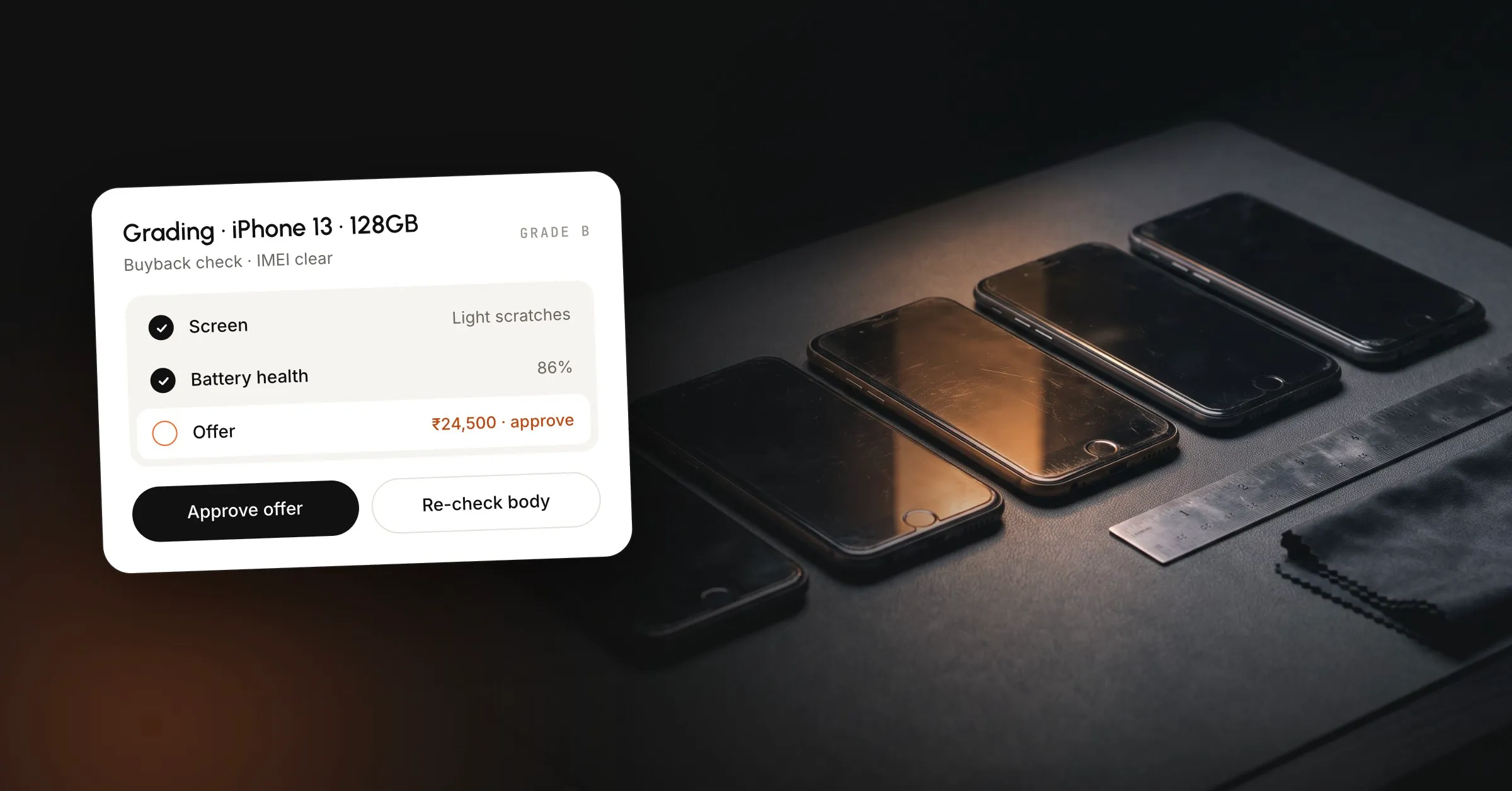
A grade is a name for checks you already do, in the same order whoever is on the counter. Shops and marketplaces do not share one published scale. Where people use A, B and C, the letters almost always mean cosmetics: glass and body at arm’s length. Battery health, a phone with no lock, a clear finance status and a clean IMEI are separate ticks. Record a functional fail as a repair, a parts unit, or a no, because a polite grade C would hide it.
Use the shop’s words, “A / B / C” or “ready” and “spare”, because a checklist nobody recognises gets skipped. Check screen, body, battery health, face or fingerprint, network, and whether you could sign the old owner out, in the same order every time. The list is a note your staff would have written about that phone, and it does not certify the board.
We do not install a diagnostics bench, and we do not certify a data wipe to a named laboratory standard. A locked, financed or odd phone waits until someone decides what to do with it. Photos of the screen and the body, before cash leaves, are what you still have when the seller says the scratch was not there.
The offer is arithmetic from rules you already use:
The draft can show the sum, and it must not move cash. A high-value unit, a mismatched IMEI, or a failed functional tick waits for a second person.
These figures are a worked example so the arithmetic is visible. They are not a shop we have measured, and they are not a promise of a margin.
| Line | Amount |
|---|---|
| Expected resale if the grade holds | ₹18,000 |
| Repair already visible, a battery | ₹2,200 |
| Margin the shop wants to keep | ₹3,000 |
| Offer a person may pay | ₹12,800 |
The engineer then finds a cracked frame. The part is ₹4,500, not ₹2,200. Cost in is now ₹12,800 plus ₹4,500, which is ₹17,300, against an ₹18,000 resale. The margin left is ₹700, not ₹3,000. Because the repair sits on the same IMEI, the tag changes before the phone is offered, or the phone is broken for parts. You still cannot unpay the ₹12,800. You can stop the next offer from repeating the miss, because the checklist now has a line for “frame, not just battery”.
Write the fault, the part and the photos on that IMEI, so the next person can open them without hunting through a staff chat. A job stays open until the photos are on the record. “Is it ready” goes out from your WhatsApp Business number after someone approves the wording, and it stays off the engineer’s personal phone.
Put the repair cost on the record before anyone writes the resale price. A grade can suggest a band, and the tag stays open while the phone is in pieces.
When a unit you sold comes back under cover, the record shows which cover applies before anyone is sent: AppleCare, your AMC, an insurer, or chargeable. A person confirms that line. Store the cover on the unit from the document you checked, so nobody has to guess it from the model name.
The electronics job we have scoped is a service desk, and it is not a finished buyback. A Mumbai Apple sales, service and rental partner still has one coordinator desk between every job and its engineer, on three surfaces: web, Android and iPhone. The goal we scoped is 24 minutes down to 3 minutes per task. The build is scoped, and the results are not in yet.
| Moment | On the unit record | In the Tally batch |
|---|---|---|
| Buyback | Grade, checks, offer, who approved | Purchase, quantity 1, the rate you paid |
| In repair | Fault, part, cost, photos | Still in stock, and parts sit outside the batch |
| Ready | Resale price, written after the real cost | Purchase rate unchanged |
| Sold | Invoice number, warranty you gave the buyer | Sales voucher, and the closing quantity is gone |
| Returned | Refund, the new fault, grade reopened | Same batch name back to quantity 1 |
The middle column is the phone, and the right column is the books. They meet on one string, and they stay separate documents. Tally remains the book, so we do not keep a second cost ledger and hope the voucher matches it.
The cover you inherited, the warranty you print for the next buyer, and a distributor’s cover on a part you fitted are three dates. Shops that file all three under one word later argue about which date a return falls under.
Do not type “in warranty” because the phone looks new. Check it against the IMEI or the serial. The warranty you give is the promise you will honour: 30 days, 90 days, store only, no liquid. The part’s cover stays on the part.
Tally’s expiry field is the wrong home for any of these, because the current help ties it to perishable goods. A phone that is merely out of brand warranty must still be sellable, so leave expiry off on handset items. Track supplier cover and customer cover as two dates, since one native expiry box cannot hold both.
Keep a rented unit off sale stock. A booking and a resale tag on the same serial promises one machine to two people, so rentals stay off the sale godown, the same rule we use for rental businesses.
Three moments are expensive to take back, so the draft stops there.
Copying the IMEI into the ticket, showing the godown, and flagging that this model often needs a battery can move without a tap, because they are easy to undo. A wrong confirm on a grade word reprints for months, so only the checklist the team actually sends is remembered. A one-off price stays on that unit.
If English is not the language engineers think in, the screen can run in Hindi, with the same photos and the same close rule. We talk to the people who will tap it before that screen is designed.
A batch of one stores the string, the quantity and the rate. It will not prove a phone was never reported lost, and it will not refuse a duplicate IMEI. The second IMEI, the grade, the photos and the parts have to live on the unit record. Pricing the offer, certifying a wipe, and posting a voucher when the fields happen to be full stay with a person. We can record the checks your shop defined, and we do not install a lab.
If the item master is a pile of near-duplicate model names, fix that list for the models you buy back before you automate the counter. When two names both match, someone has to guess, and that guess is how the wrong item gets the IMEI.
Pick the lane where the 15 digits are typed most often. Often that is the buyback offer that waits for a yes, or the ticket that fills from a serial. The current portal or sheet can stay while that lane is proven.
It is live in 3 to 6 weeks, with the people who will use it testing it. AMC visits, rental units kept off the sale godown, and a daily summary come after that lane is what the team opens. If it does not earn its place, the setup fee comes back within 45 days.
Before a phone reaches this record it has to be graded and priced, which we cover in refurbished phone grades and the buyback price. How the resale is taxed under the margin scheme is in GST on second-hand mobiles.
The test is one phone you bought, repaired and sold last month. If you cannot put the offer, the parts and the voucher on one line without opening three files, build that lane. We build it on your Tally and your WhatsApp number, for sales and operations, and you own what we put in. The shape of the work is on what we build. Bring one IMEI, and we will trace what Tally already holds and what still needs a person.
No. An IMEI or a serial is for a unit you can sell once. A charger, a glass or a battery in the drawer is quantity stock, with its own item and godown. Putting a batch on every accessory makes the purchase screen unusable on a Saturday. Save the batch for phones, laptops and other units that carry a warranty or a resale price.
Tally's batch holds the number, the godown, the quantity and the rate. The seller's name, phone and the ID you checked belong on the unit record next to the IMEI, in whatever form your shop already uses. Do not type an ID number into a narration that prints on the customer's tax invoice.
Pass a sales return or credit note on the same batch name, so the unit comes back as quantity 1 instead of a new row, and reopen the grade. The refund and the fault belong on that record before anyone offers the phone again. Treat the return as a fresh buyback only if you paid a new seller.
No. A handset occupies one godown at a time. The batch allocation asks for a godown, and a transfer is a stock journal that moves that same batch. If two godowns both show quantity 1 for one IMEI, someone typed the number twice. Sell from the godown that actually has the phone.
No. Write down who approved the Saturday price and what they saw, so the price stays on that unit. A Saturday price can be lower because the customer is buying a laptop in the same visit. The next phone starts from the checklist and the margin rule for that handset.
No. Keep the portal or the sheet while one lane is proven, usually the buyback offer or the ticket that fills from the serial. Once that lane is what the counter opens, you decide what the old screen is for. Use that first lane as the test of the setup.
Dealers pay GST on the margin of a used phone when Rule 32(5) fits. Exchange, buyback, the invoice line and the Tally entry, with the rules linked.
What A, B and C mean on a used phone, with a grading sheet and a rupee buyback you approve before paying.
AI for MSME India pays back on Tally and WhatsApp desk jobs. Sensors and forecasts wait until the data exists. What to run first, and what not to buy.
Book a 30-minute call. We'll map the workflow costing you the most hours and tell you honestly whether AI can fix it.
Book a 30-min call