How to start an equipment rental business in India
How to start an equipment rental business in India: one fleet, GST as a service, and a deposit that is not the hire.
The columns a rental desk needs for bookings, availability, deposits and GST invoices, and where that sheet still double-books a unit.

Nimish Gahlot
Founder, Empulse Labs
· Updated · 14 min read
Published
Updated · 14 min read
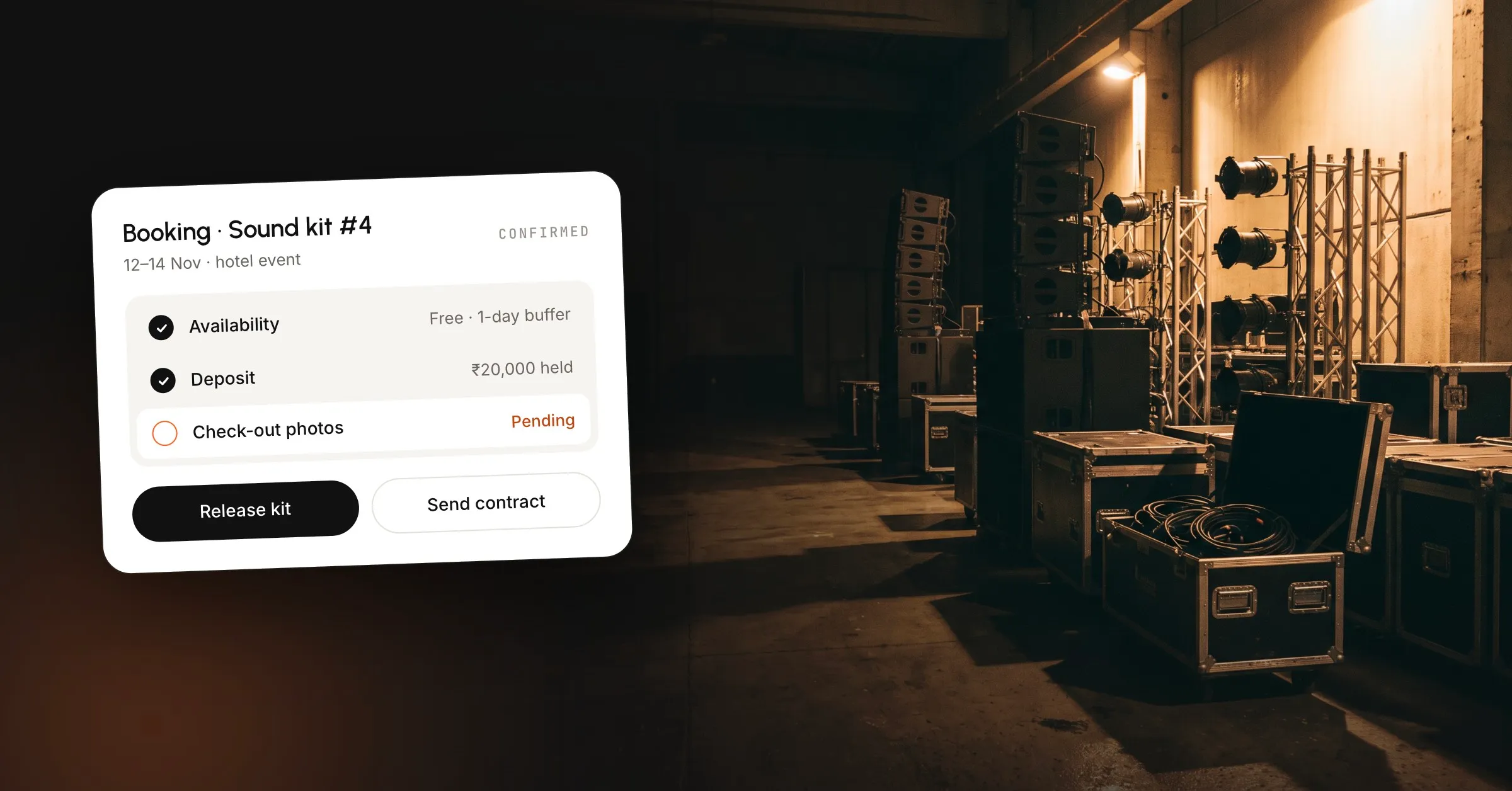
An equipment rental management excel template is the workbook that has to answer one question before anyone says yes: is this unit free on these dates, and is the deposit a separate figure from the hire. One set of rows holds the serial or the quantity, the booking, the buffer after due-back, and a deposit that stays off rental income. The tax invoice sits on its own row. One person can keep that file straight. Once a second person promises the same light tower from WhatsApp, or a machine in the workshop still looks free, the file is no longer enough.
Five lists keep the deposit, the tax, and the next booking from landing in the same cell, which is where they end up on one wide row.
| Sheet | One row is | Keep these true |
|---|---|---|
| Units | A serial, or a bulk item you own | Id, quantity owned, status, where it is, meter or next service |
| Bookings | One hire of that unit | Customer, dates, buffer, rate, and quote, hold, confirmed, out, or closed |
| Deposits | One receipt or one card hold | Amount, mode, reference, released or applied, and the name |
| Invoices | One bill for a period | Taxable hire, tax, hire balance, a pointer to the deposit |
| Missed jobs | An enquiry you could not fill | Kit, dates, why you said no, a rough value |
A yellow cell that everyone calls reserved still goes to whoever saves the file last.
A laptop without its charger, a tent without poles and sidewalls, or a car without the spare is a kit the next customer was promised. Put those parts on their own rows, tied to the parent id, when a missing part would stop the next handover. Two hundred identical chairs can stay as a quantity, and forty still out are a quantity of forty.
The enquiry arrives on the business WhatsApp number, or on the phone, as a date and a vague noun: “the tower”, “twelve laptops”, “the 20 by 40”. Reply with a specific id or a specific quantity, because “we have towers” is how two customers get the same machine.
The quote names the customer, the unit, the start, the due-back with a clock time and a place, the rate, how you count days, the deposit amount, and what that deposit may later be applied to. Delivery or setup, if you charge it, is its own figure. If the agreement asks for a GSTIN, a purchase order, a driving licence, or an insurance certificate, the row stays a quote until that file is on the order. Collect the documents your agreement already names, because a missing paper stops the handover.
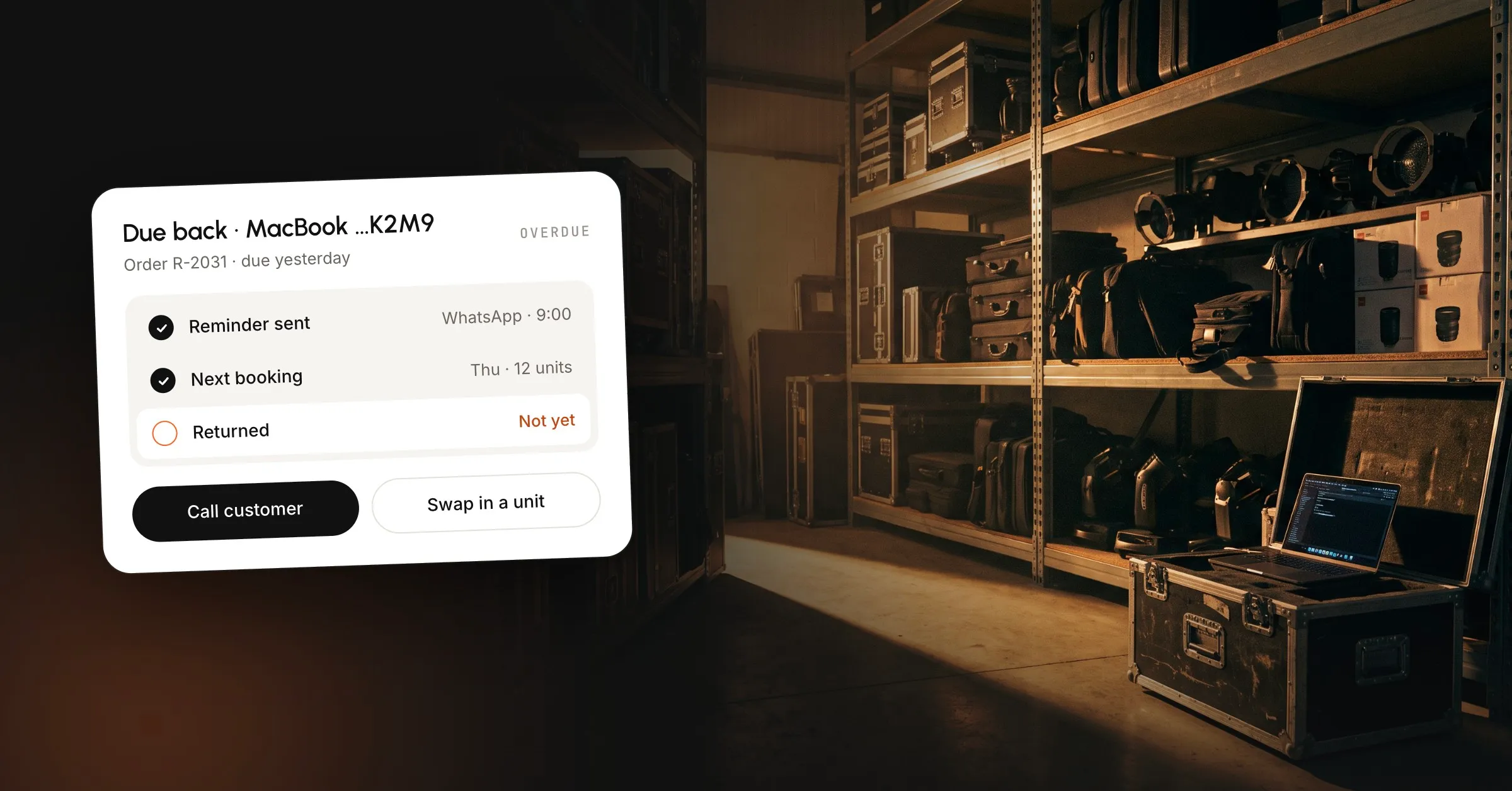
The late-return sentence belongs on that quote before the deposit is taken. The buffer, the fee, and the chase are in the equipment rental late return policy. Use those words on the order.
Name who may confirm, usually the owner or the counter lead, and have them sign the row when it leaves quote. A WhatsApp “ok” stays a request until that name is on the row and the overlap check has been run again, because dates move and a unit can fail a check in between.
Free, on rent, in transit, and in service are the four statuses a counter already uses, and owned quantity is only the starting number. On rent stays unavailable past due-back until someone records what happened. In transit is the trip out or the trip home, and in service is a failed inspection, a scheduled service, a missing part, or a clean that takes the rest of the day. A sheet that only knows “out” and “back” will hire the machine that came home broken.
Lag is the pad after due-back, even when the customer is on time: the check, the count, the fuel, the charge, the dry, the reload. A laptop may need half an hour, a tent that has to dry may need the rest of the day, and a car needs photographs and fuel. Lead time is the same pad before the hire, so a 9am delivery is one the yard can load. The next booking starts only after due-back plus that lag. A grace period changes the bill for a short overrun, and the dates stay blocked through it. The fee and the waiver sit in the late-return policy.
Hour-meter machines need hours at the last service and hours at the last check-in. If the hours you expect on the next hire would cross the interval you set, status goes to in service before anyone confirms. A service note in a chat leaves the row looking free, and the WhatsApp reply then offers a machine the workshop already has.
Take what you own and subtract overlapping confirmed quantity, quantity in service, and whatever you need to count and repack. What remains is what you may promise, and a negative number is a shortage. Someone then chooses another date, a smaller quantity, or a sub-rental from another yard. The sheet can store that choice, and a person still has to send the other yard the order. The turned-away job still needs a missed-jobs row, or a busy month and a short fleet look the same.
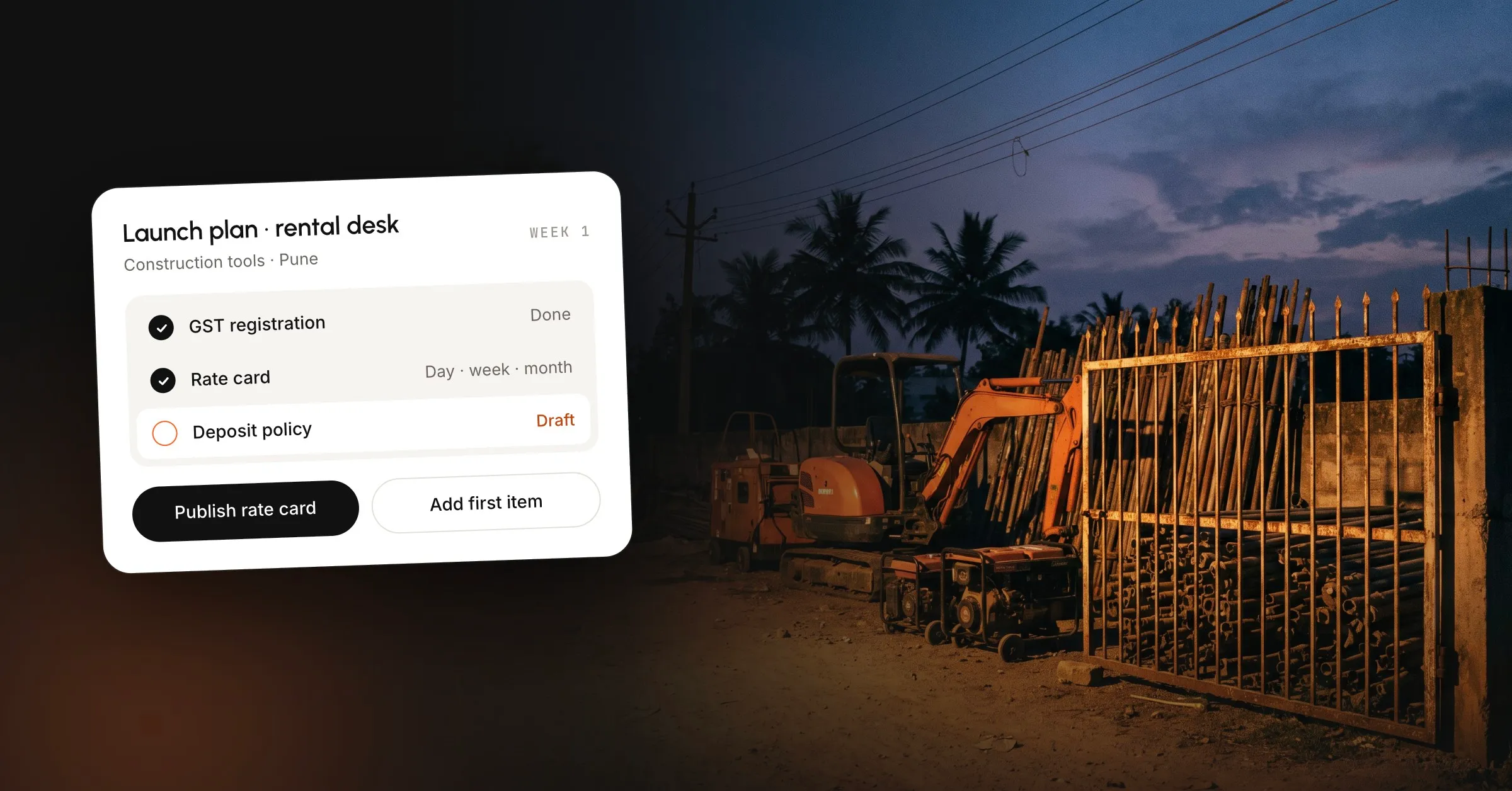
Size the deposit from repair or replacement exposure rather than from a few days of hire. A fixed amount for a class of gear is the easiest to apply every time. A percent of the order fits a short, cheap hire, and a higher figure on the expensive serials fits a fleet where one machine carries most of the risk. Write the rule on the rate card. A customer with a clean history can sit lower, or on none, if a named person writes that exception on the order.
Record the mode and a reference: UPI transaction id, bank reference, cash taken by a named person, or a cheque number. Indian yards usually already hold the money, and there is no card authorisation behind that receipt. In Dubai a company paying by card may give a pre-authorisation instead. Record the amount, when it was placed, and the expiry the bank gave you, so a hold that drops off mid-hire shows on the order.
While the deposit is refundable it is a liability. Hire income is a separate ledger, and a part-payment of the invoice is a separate ledger too.
Tally’s default groups put a deposit the company has paid under Deposits (Asset). The same page calls a deposit the company receives a liability: “not received by the company, which is a liability.” The receipt debits cash or bank and credits a ledger such as security deposits received. A refund debits that liability. Applying part of it to a damage line or an extra day is a named person’s entry, and reversing that charge later is a credit note.
Your CA or your tax agent owns the entry on a real order. The split below is how we stop the deposit being taxed by accident.
Under the CGST Act, Schedule II, a transfer of the right to use goods for consideration is a supply of services, and the hire is that supply. The rate sits in Notification No. 11/2017-Central Tax (Rate) against heading 9973. The entry for leasing or renting of goods has followed the rate on a supply of the like goods, so this guide does not print one percent for every machine. Confirm the entry before the invoice goes out.
The proviso to section 2(31) of the CGST Act says a deposit given for a supply is not payment for that supply unless the supplier applies the deposit as consideration. Until someone applies it, it stays out of taxable value. The tax invoice carries the hire, and the deposit is the receipt against the liability, referenced on the order.
Circular No. 178/10/2022-GST (3 August 2022) says that where a customer booked a service and then did not take it, a forfeited deposit is assessed at the rate of that service. The examples are air travel, tours, and hotels. A no-show fee taken from a machine deposit is the same conversation with your CA, and this guide does not print a rate for it.
Inside a state the invoice shows CGST and SGST, and across states it shows IGST. Which pair applies when the machine crosses a state line is a place-of-supply question for your CA. The sheet stores the tax you charged, split the way the invoice shows it.
In the UAE, Federal Decree-Law No. 8 of 2017, Article 3, republished with amendments through 2025, imposes tax at 5% on a taxable supply, and the hire is that supply. A refundable deposit is recorded beside it, and it is not folded into that 5% until you apply the amount to a charge. Later amendments show on the FTA legislation page. Read them against the contract you issue.
Shoot on the way out, while the customer is still there, because a first photo taken only at return is a weak argument about a scratch.
On the way out, shoot the serial or the quantity, the kit, and the surfaces you would argue about later: lid, screen, sides, bumper, tread, hitch. Put the time, the customer, and the order on the same thread, or on the paper that leaves with the goods. On the way back, shoot the same list and write the actual return time. Retake a blurry frame before they leave, and file the set before the driver’s phone is the only copy.
A person compares the two sets before any damage line, and the frames can be filed against the serial automatically. The customer hears about a charge from your number only after a person has posted it.
Title stays with you, the tax invoice is for the hire, and the machine still has to leave with a document. Rule 55 of the CGST Rules allows a delivery challan, serially numbered up to sixteen characters, when goods move for reasons other than by way of supply. It carries the date and number, consignor, consignee, description, quantity, and a signature. Where the movement needs an e-way bill, the rule points at rule 138. Store the challan number on the booking, because a gate will not take a voice note in its place.
A failed check opens a workshop line: unit, fault, parts, and the date you expect it clear. Status stays in service until that line is signed. Cleaning that always takes an afternoon belongs in the lag. Until the name is there, the sheet does not put that serial back on offer, and a WhatsApp reply that reads the sheet does not offer it either.
A short hire gets one invoice. Pick start or return, and use that same point on every short hire. A long hire, a laptop fleet or a machine with no end date, needs an invoice day, a period length, and a rule for dates that move mid-hire. Prorate only when the agreement says so. A blank end date never appears on “due back today”, so give the row a billing date or it will miss the invoice list too.
Rule 46 of the CGST Rules sets the particulars: a serial number, supplier and recipient, a description, taxable value, and the tax. On a hire, the description is the unit or the quantity, the period, and the rate. Delivery you charge for is its own line.
| Line | On the tax invoice | Where the money sits |
|---|---|---|
| Hire for the period | Yes, at the rate for that supply | Sales |
| Delivery or setup you charge | Yes, on its own line | Sales |
| Refundable deposit | No | Liability, via a receipt |
| Damage or extra hire a person posted | Yes, once it is a charge | Sales, then a credit note if you reverse it |
Hire still owed is the invoice minus payments of hire. An open invoice is a balance, and a unit still out is the next customer’s machine, so the two stay on different lists. If you are inside the e-invoice mandate, the customer also needs the IRN. Confirm the current threshold with your CA before you add that column.
Nobody hired these units. The amounts are arithmetic for checking the columns, and they are not a rate card.
Light tower LT-14 is due Wednesday at 16:00, with four hours of lag, so the next start is Thursday at 08:00 if that return is on time. A 09:12 WhatsApp message asks for Thursday to Sunday, and the overlap check is clear. On this made-up card the daily rate is ₹1,800, Thursday out through Sunday back is four days, and the taxable hire is ₹7,200 if you count both the out day and the back day. The light-tower deposit on the same card is ₹25,000, recorded when the UPI reference arrives, and kept off the ₹7,200.
A second message wants the same tower on the same dates, and the overlap check now returns one. The reply offers the next free window or a substitute, and the missed-jobs row stores the kit, the dates, and a rough value. A sub-rental happens only if a person decides to place it.
The same Saturday a wedding wants 80 chairs. You own 100, confirmed overlaps already take 30, and 10 are in service, so the quote is for 60 rather than the shelf count of 100.
If the four days are confirmed, the LT-14 invoice is the ₹7,200, and the ₹25,000 stays on the deposit receipt until a person releases it or posts a charge.
Once due-back has passed, leave the unit unavailable until a person records an extension, a swap onto a checked serial, or a finished inspection. The buffer on the bill, the extra hire, who may waive it, and the WhatsApp wording are in the late return policy. The management sheet stores the outcome: a new due-back, still out, or in service, plus any extra hire a person added as a line.
Utilisation is days on rent divided by days you were prepared to hire the unit, with in-service days taken out of the second number. Eighteen on rent and four in service, in a 30-day month, is 18 over 26. The missed-jobs list is what shows the second tower you turned away. Revenue against the unit’s cost flatters the month if the deposit was booked as sales.
On Monday the counter checks:
The last save wins if two people edit. A WhatsApp reply does not read the file unless a person looks, a chat note does not flip a status, and photos stay on the phone that took them. A model can draft a quote from a row that is already true. Confirming the hold, choosing the GST rate, releasing a deposit, and calling two photographs a charge stay with a named person, because the customer sees each of those and a wrong free count spreads as soon as the draft is sent.
The equipment rental firm on our rental businesses page had a different hole in the same loop. Billing sat in an old flat-file system with no reminders, and the ERP vendor can take 15 days to answer. The proposal is a one-week pilot of payment reminders on WhatsApp and email, beside that ERP, before availability. The goal of that pilot is zero invoices left to memory. The page says the results are still to come.
If two people are fighting over the file, map that workflow. We build it on the sheets, Tally, and WhatsApp number you already run, for sales and operations, and you keep what we build. How a build runs is the engagement: one system, live in 3 to 6 weeks, with the setup fee back if it does not work in 45 days.
Excel and Google Sheets both open these columns, and neither locks a row while someone types a yes. The last save wins, and an overlap formula only sees rows that have been saved. If the counter and a WhatsApp reply both use the file, one person should own the bookings sheet that day.
The deposit is money you are holding, and the balance for hire is the invoice minus payments of hire. A sheet that subtracts the deposit from the rental total shows a cleared hire when the customer has only parked a deposit. Deposit receipts stay on their own rows, and the invoice balance ignores them until a named person applies one to a charge.
Give the part its own row when a loss would stop the next handover. A charger sits against a laptop serial, poles and sidewalls against a tent, and a spare against a car, and the order lists that kit. At check-in a missing part is its own line, and the parent stays off the free count if the next customer was promised the full kit. Identical chairs can stay a quantity.
Write down the day, the kit, the dates they wanted, and why you said no: no free unit, the machine in service, or the price. A rough hire value is enough. That list is how a Monday meeting separates a buying question from a quiet week, which a workbook that only stores the orders you won cannot answer.
A card pre-authorisation is a hold at the bank, so it is not cash in your account, and it can drop off before a long hire ends. Record the amount, the time, and the reference on the order. A transfer is recorded the same way a UPI receipt is recorded in India. VAT sits on the hire, and the hold stays on its own line.
Only the person who signs the workshop line may mark the unit free, even when someone else wants the next booking. Free means the check passed, the kit is complete, and the buffer after the last hire has been used or explicitly cleared. A chat that says the repair is finished does not change the status cell, so the next yes waits on that cell.
How to start an equipment rental business in India: one fleet, GST as a service, and a deposit that is not the hire.
How to write an equipment rental late return policy, set a buffer, and chase the unit before you cancel the next booking.
AI for MSME India pays back on Tally and WhatsApp desk jobs. Sensors and forecasts wait until the data exists. What to run first, and what not to buy.
Book a 30-minute call. We'll map the workflow costing you the most hours and tell you honestly whether AI can fix it.
Book a 30-min call