Equipment rental management excel template: bookings, deposits and billing
The columns a rental desk needs for bookings, availability, deposits and GST invoices, and where that sheet still double-books a unit.
How to write an equipment rental late return policy, set a buffer, and chase the unit before you cancel the next booking.

Nimish Gahlot
Founder, Empulse Labs
· Updated · 15 min read
Published
Updated · 15 min read
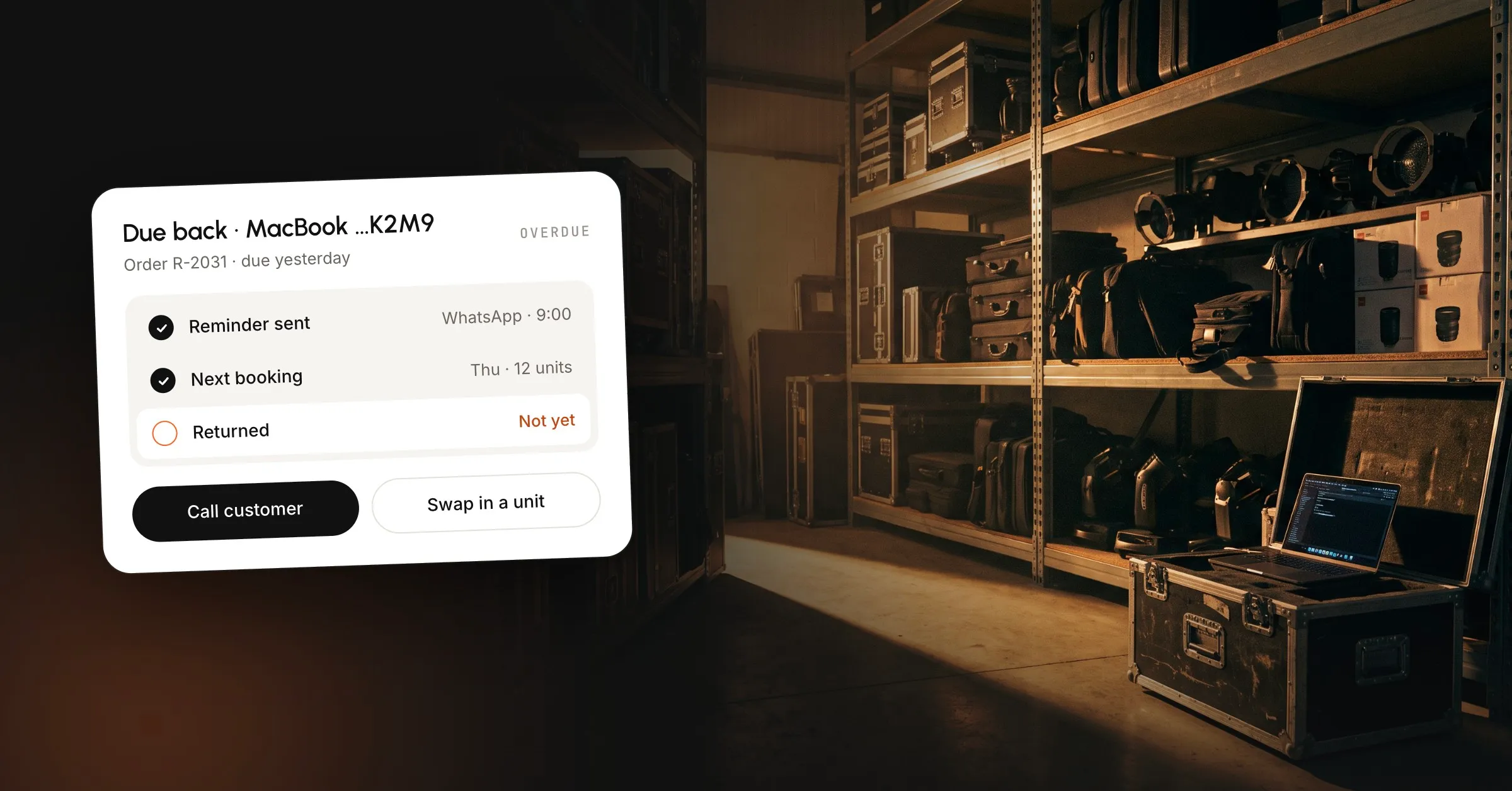
An equipment rental late return policy is the written rule for a unit that is still out after the time you promised it back. Before you touch the next booking, leave the unit blocked, see who is waiting, and pick one outcome: a longer hire, a shorter extension, a swap onto a free serial, or the return you already agreed. A late fee is a line a person adds, and only when that fee was on the agreement before the unit left.
On an equipment, laptop, car, or event fleet that still runs from a sheet and WhatsApp, the counter says yes to a second customer while the first unit is out.
A grace period is a short window past due-back with no extra hire. Use it for traffic, a slow loader, and the customer who is half an hour out. State the length and apply it to every customer. A grace you hand out when you like someone is a favour, and regulars notice who gets it.
After that window, match the charge to the fleet. A laptop desk with several of the same model can use 30 to 60 minutes, then an extra day. Waive that day once, in writing, for a clean history and a warning sent before they were late, and post the line the second time. A single tent, light tower, or car has no spare, so the charge is an extra day at the daily rate, because that day is the next job. Where you already sell weekly and monthly rates, a long overrun can step up to the next rate you publish, as further hire. On bulk stock, you bill the quantity still out: forty chairs still out, from an order of two hundred, are forty chairs late.
The customer should see the rule before they pay a deposit or take the unit. A sentence on the quote and the same sentence on the order is enough. We adapt this version per fleet:
“This unit is due back on the date and time on this order, at the place named there. A return inside the buffer written on the order carries no extra hire. After that buffer, each day or part of a day the unit is still out is billed at that unit’s daily hire rate. If a confirmed booking has to move because this unit is late, we will say so before we move it. A late charge is a line we add to this order after the return. It is separate from the deposit.”
Change the buffer and the rate to yours. Keep the last two sentences, because they are what stop a surprise deduction. Put the same words on the quote and in the WhatsApp thread before the unit moves, and store them on the order.
An early return frees the calendar once check-in is done. It refunds held days only when the agreement says so. Pick one rule, no refund or a credit on the next order, and use it every time. Reopen the dates the hour the unit is ready, so they do not stay blocked until the old end date.
A no-show is a pickup that never happens. Message at the agreed time, then release the dates after the wait you wrote down. A party order can wait until the next morning. A car with the next driver in the yard may go out the same day. Take a no-show fee from the deposit only when the agreement already says so.
Once the unit is overdue, it stays unavailable until a person records what happens next.
A grace period changes the bill only, so a unit inside a two-hour grace is still out and the next handover still waits on a real return. Teams that mark the unit free at the start of grace are booking a machine that is on a road.
Lag time sits on the serial after the hire is supposed to end, even when the customer is perfectly on time. It is the check, the count, the charge, the fuel, the clean, and the reload. A calendar that treats 10:00 back and 10:00 out as the same minute will double-book two people who did nothing wrong.
Put the lag on the unit. A laptop may need half an hour. A tent that has to dry and be repacked may need the rest of the day. A car needs photographs, fuel, and a wash. Lead time is the same pad before the hire starts, so a 9am delivery is one the workshop can actually load. Grace and lag can share a length, with grace changing the bill and lag deciding whether the next customer has a unit that can leave.
A unit that is back is in your custody, and it is free only when it is ready to go out again. A cracked lid, a light tower that failed the test, or a car with a new scrape goes to in service, and that serial stays off the free count until the workshop clears it. The repair has to live on the order, because a chat note still leaves that serial looking free.
Use three steps, and make the third a call from a person, because a longer thread is how customers mute the number.
Send it from your own WhatsApp Business number, on the thread they booked on when you have one. Outside the 24-hour customer service window, which opens when they message you and resets with each message from them, the WhatsApp Business policy allows only an approved template. Inside the window you can talk normally, including with automation, as long as they can still reach a person by phone, email, or at the counter.
A due-back note is a utility template when it is specific to their order and carries no offer. Meta’s template categories require a utility template to be non-promotional. “Book your next hire at 10% off” is a different category, and it will get the reminder rejected or repriced. Name the unit and the time, tell them how to ask for longer, and leave the discount out.
One message, in words you would type yourself:
“MacBook Air 1842 is due back today by 5pm at the counter. Reply here if you need it longer. We check the next booking before we agree.”
If the order is a quantity, name the quantity and what is in the kit. “The 20 by 40 tent, poles, and sidewalls” brings back a complete tent, and “Your order” brings back whatever they remember.
Later the same day, if the status is still out, send a second message, and make that the last one.
“MacBook Air 1842 is still out. We will call today. Tomorrow’s booking on this serial stays held until we know where it is.”
Record the send and any reply on the order. A plan that exists only in one person’s phone disappears at the shift change.
The third beat is a call task with the unit, the customer, the due-back time, and the next booking. The call is where you learn they are twenty minutes away, they thought the hire ended tomorrow, or the unit is already in the yard and unmarked.
Stop the return messages once the return is marked. A payment that arrives while the unit is still out leaves that chase open. An open balance on a unit that is home belongs on the invoice ladder, day 25, day 28, and a call at day 35, and that ladder stops when the balance clears.
A changed date in a chat leaves the price, the deposit, and the next shift where they were.
| Situation | Calendar | Charge | Who decides |
|---|---|---|---|
| One tent or tower, next job the same day | Stays blocked | Extra day, if the clause allows it | A person calls both customers |
| Several identical laptops, one late | A free, checked serial moves to the next order | Extra day on the late order | A person confirms the swap and tells the customer if a serial was promised |
| Extension asked, nothing after it | New due-back written, with the same lag after it | Extra hire for the extra time | Whoever you named in the policy |
| Back, check failed | In service until the workshop clears it | Deposit waits | The person who compared the photos |
| Chairs or linen, some still out | Only the missing quantity stays committed | Hire on that quantity | The count at the warehouse |
Use this Monday as a worked example with no client result behind it. The only 20 by 40 tent is due at 10:00, with a wedding pickup at 16:00. At 10:30 it is still out and there is no second tent, so the order keeps the original return. Call the current customer and, in the same hour, call the wedding with a later pickup or a release. Waiting until 16:00 spends the only hours that wedding had.
The same morning, MacBook Air 1842 is due at 11:00 and promised again at 13:00. Move a checked spare onto the 13:00 order, and say so if a serial was already named. A machine that is in service stays off that swap until the workshop clears it. Approve an extension only when the new end, plus lag, clears every booking already confirmed.
A late fee and a scratch collapse into one argument when the only photo is the one taken at return. The customer says the mark was already there. Without the handover frame of that lid, that panel, or that bumper, you are guessing, and the deposit is where the guess lands.
On the way out, while the customer is still there, shoot the serial or the quantity, the kit (charger, lens, poles, sidewalls, spare, hitch), and the few angles you will argue about later: lid, screen, sides, bumper, tread. Put the time, the customer, and the order on the same thread, or on the paper that leaves with the goods. On the way back, shoot the same list and write the actual return time. Write a missing part as its own line, and retake a blurry frame. A photo that is still on a driver’s phone has not been filed on the order.
A person compares the two sets and writes a damage line only after that look, and you keep a model from declaring the difference. The customer hears about the damage from your number. A late return shortens the time you had for the comparison, and the unit stays blocked until the look is done.
Record what you took, and how: UPI reference, transfer, cash, cheque. In India the hold is often an amount you have already received and can show, with no card hold behind it. It sits on the order beside the hire, and it stays off rental income while it is still refundable.
Most fleets need one of three figures, written down: a fixed amount for a class of gear, a percent of the order, or a higher amount on the expensive serials. A regular with a clean history can sit on a lower figure, or on none. A different number at every handover is how the deposit becomes a negotiation.
Release it when the return is clean and a named person says so. Apply it to a late day, a missing part, or a scratch only when that same person, or a second person if you split the jobs, posts the charge. The message may warn that a charge is coming. It does not move the money.
For a car in Dubai, the handover photos are a contract record as well as a habit at the counter. The Roads and Transport Authority’s notice of 24 March 2026 on the unified contract for car rental offices says the contract records the vehicle’s condition at handover and at return in images, bars undisclosed fees, and requires the security deposit to be refunded within the timeframe the contract specifies. Read the RTA notice against the contract you actually issue.
This is how we run the invoice. Tax and contract questions on your own orders go to your CA or your lawyer. Consumer rules apply when the hirer is a consumer. A site contractor can sit outside them. If a regular account might be either, ask before you print the clause.
Circular No. 178/10/2022-GST (3 August 2022, still the GST Council circular on this question) is the line on the invoice. A payment is taxable when it is consideration for a supply, whatever you call it. An amount that only compensates a breach, with nothing supplied in return, is described there as a flow of money. Extra days the customer keeps the unit are more hire, billed at the rate already on the order. A penalty that buys no time is a draft for your CA, and we do not invent its tax treatment. The same circular says a forfeited deposit, where the customer paid and then did not take the service, can be taxed like the service they booked. A no-show fee taken from a deposit belongs in that conversation with your CA, and it stays out of the WhatsApp template.
Under the CGST Act, a deposit given for a supply is not payment for that supply unless you apply it as consideration. Until a person applies it or refunds it, keep it off the rent line in Tally. Reversing a damage charge is a credit note. The customer should be able to see the deposit, the photos, and who released it.
India’s Consumer Protection Act, 2019, section 2(46), calls a contract unfair when it demands a manifestly excessive security deposit, or a penalty wholly disproportionate to the loss from the breach, in a contract with a consumer. A late fee with no relationship to a lost booking, or a deposit that is simply the largest number the counter could think of, is the clause to put in front of counsel before it is printed.
On the UAE government page on consumer protection, updated 2 September 2026, Federal Decree-Law No. 5 of 2023 amending Federal Law No. 15 of 2020 prohibits and voids contracted conditions that would harm the consumer, and voids a clause that lets the supplier skip obligations in that law. A fee the customer could not have seen before pickup is the fact pattern. The page states the rule and leaves the amount to the contract you issue.
The first build is a list the counter can read before the shop opens.
One template goes from your WhatsApp Business number, in your words, and the call task lands with a named person. Fee lines and deposit releases stay manual. A week of that loop shows the regular who is always an hour late, the unit that came back and was never checked, and the open-ended hire that belongs on a billing date.
The photo set, and a reply that says how many units are free, come after the list is dull and right. Free has to mean back, checked, and not already promised. A pilot that chases units already on the shelf gets switched off.
The equipment rental firm on our rental businesses page is the payment version of this shape. Billing sat in an old flat-file system with no reminders, and the ERP vendor can take 15 days to answer. The pilot is one week of payment reminders on WhatsApp and email, beside that ERP. Zero invoices left to memory is the goal, and the page says the results are still to come. That goal stays on the payment pilot, and this post does not count it as a late-return result.
A person posts the late fee, confirms a swap, compares the photos, and releases or applies the deposit. The template stops when the return is marked, and messages go from your number. We have not measured your week, so we will not present another company’s admin-time claim as a figure from yours.
Late returns are one part of running the desk. The full routine, from the booking to the invoice, is in our equipment rental management guide, and if you are setting up from scratch, start with how to start an equipment rental business in India.
If the late unit is the hole you want closed, map this workflow. We build it on the tools you already run, for sales and operations, and you keep what we build. How a build runs sets out the engagement: one system, live in 3 to 6 weeks, with the setup fee back if it does not work in 45 days.
Name one role, usually the owner or the counter lead, and have them write the waiver on the order. Waive the fee once when the customer has a clean history and sent a message before the unit was late, and post the line the second time. A waiver that lives only in a chat, with no name on the order, becomes the rule the next customer will quote back at the counter.
Show the agreement they saw before pickup, the due-back time, the recorded return time, and the line on the order. Inside the buffer, there is no extra hire to defend. If your handover was late, or the unit failed its outgoing check, waive the charge and write why on the order. Show the file when they dispute it, and leave the clause in the agreement.
A reply is a request until someone checks the next booking and writes the new due-back time, place, and any extra hire on the order. A yes that lives only in the chat leaves the counter believing the unit is due today, and the next customer can be promised a machine that will not be there. Send the confirmation after the order is updated, from the same thread.
Check the laptop in if it passed inspection and the next customer can take it. The missing charger is its own line: a spare from your shelf, a charge, or the laptop held in service until a charger is with it. Keep a partial kit off the free count when the next order was promised the full kit. Bill only the pieces that are still out.
Late means the due-back time has passed and you still expect the unit home. Missing starts when the wait in your agreement has run out and the customer has gone quiet, or when they say the unit is lost. The loss clause, the deposit, and a call from the owner replace the reminder, since another week of the same due-back note will not find the unit.
Run the return and the invoice as two chases. The return message names the unit, the time, and the next booking that needs it. The invoice message names the open balance and stops when that balance clears. On the equipment firm we have written up, invoice reminders go at day 25, day 28, and a call at day 35. Send the invoice chase when the unit is on the shelf, and send the return chase when the unit is still out.
The columns a rental desk needs for bookings, availability, deposits and GST invoices, and where that sheet still double-books a unit.
How to start an equipment rental business in India: one fleet, GST as a service, and a deposit that is not the hire.
AI for MSME India pays back on Tally and WhatsApp desk jobs. Sensors and forecasts wait until the data exists. What to run first, and what not to buy.
Book a 30-minute call. We'll map the workflow costing you the most hours and tell you honestly whether AI can fix it.
Book a 30-min call