RBI digital lending guidelines for NBFCs and DSAs, and what changed
The RBI digital lending guidelines were withdrawn as a standalone book. NBFCs now cite Chapter III, and a DSA still cannot take the fee.
The loan origination process an NBFC or DSA actually runs, from the lead to the borrower's account, with the RBI rule at each step.

Nimish Gahlot
Founder, Empulse Labs
· Updated · 13 min read
Published
Updated · 13 min read
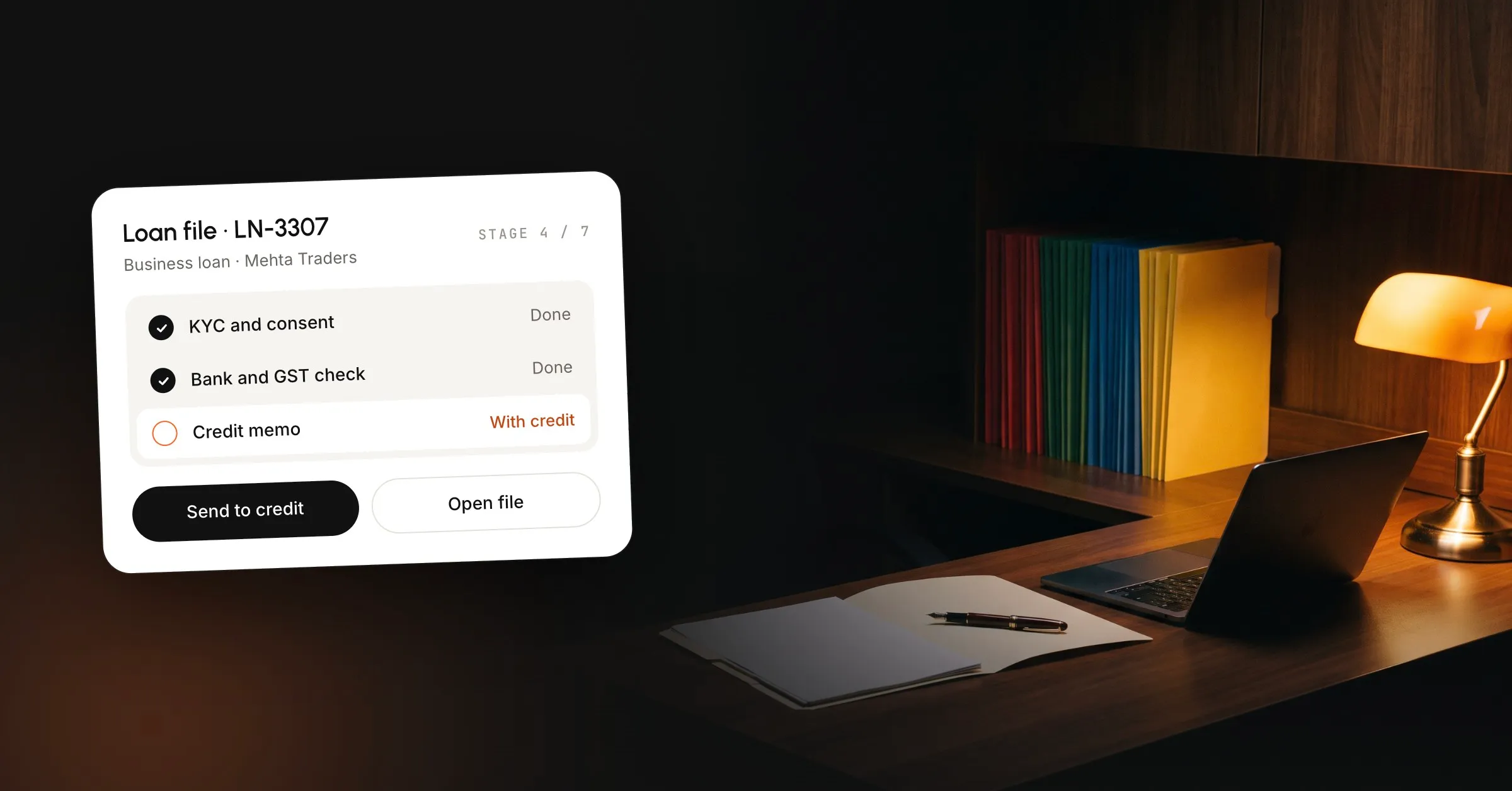
The loan origination process is the work between a logged lead and money in the borrower’s account. On an NBFC or DSA desk the loan origination process steps run through pre-qualification, KYC and consent, the document set, a bureau pull and a reading of the bank statement, a credit memo a person signs, the sanction and the Key Fact Statement, the agreement and the repayment mandate, and then disbursal. Servicing starts once the UTR is on the file. Guides that stop at four stages cover this same path with the desk’s names taken off, and the file usually stalls on a step those stages do not name.
As of October 2026, an NBFC’s digital-loan text is Chapter III of the NBFC Credit Facilities Directions, 2025, updated as on 15 July 2026. The Key Fact Statement for a retail or MSME term loan is in the Responsible Business Conduct Directions, 2025, updated as on 1 July 2026. On 28 November 2025 the Reserve Bank made those Master Directions the sole library of regulations the Department of Regulation administers. The Digital Lending Directions of 8 May 2025 are still on the site, without a repeal banner on the directions. We have not opened the annex of withdrawn circulars, so the chapter below is the one we read.
In those directions a digital loan is a remote and automated process covering acquisition, assessment, approval, disbursement and recovery. A DSA that runs any part of that for the NBFC is a lending service provider, and the outsourcing contract leaves the NBFC responsible for what the agent does. A file walked into a branch and underwritten by hand still needs a sanction letter and, for a retail or MSME term loan, a Key Fact Statement. The rest of the digital-lending paragraphs apply when the loan is actually digital.
People search the four stages as application, underwriting and verification, approval and documentation, and closing and funding. An Indian desk splits those stages into the rows below, and a few of the rows are regulated.
| Step | Done when | What binds it |
|---|---|---|
| Lead | Product, amount, city, salaried or self-employed, source | Logging is short of an application |
| Pre-qualification | Minimums and the negative list | Age, occupation and income on record before a loan |
| KYC and consent | OVD, or CKYC with consent | KYC Directions, 2025. Explicit consent on an app |
| Documents | Product checklist complete | The lender’s own list |
| Bureau and statement | Score, EMIs, bounces, GST gap written | Consent for the pull. A flag waits |
| Memo and sanction | A person signs amount, tenor, conditions | Sanction letter in the borrower’s language |
| Key Fact Statement | Proposal number, APR, schedule, acknowledgement | Retail and MSME term loans, before the contract |
| Agreement and mandate | Agreement, mandate, insurance if required | Digital loan: signed pack by email or SMS |
| Disbursal | UTR to the borrower, or the allowed end-beneficiary | LSP account barred. The NBFC pays the LSP |
| After the UTR | Schedule on the servicing system | Repayment to the NBFC. Cooling-off of at least one day if digital |
When the row moves from sales to credit, write the owner on the file. The shops we sit with keep the person who logged the lead off the sanction.
A loan origination system is the software that stores this sequence, and a loan management system starts at the UTR. The directions require the outcomes in the table.
A lead arrives on the NBFC’s own WhatsApp number, from a branch, or as a batch from a connector. The first log is product, amount, city, salaried or self-employed, and the source code, which is enough to pick the checklist and to decide whether this desk logs the file at all.
Pre-qualification checks the minimums the credit head already wrote down: ticket size, city, time in the job or the business, a restricted industry, an internal debarment list. A file that almost fits stays with a person, because a decline sent from a template is hard to undo once the applicant has read it.
The bureau stays unpulled at this step unless the lender already has consent and a bureau account of its own. The score on the file is the lender’s report: an old PDF the applicant photographs is a weak substitute, and loans that never reached a bureau still show up as debits on the statement.
A loan agency in Navi Mumbai was chasing every applicant three or four times on WhatsApp for missing pages, while one broker partner sent 600 leads. We are mapping that DSA process so the checklist runs before a person opens the file, and legal title work stays with their experts. Results are not in yet, and the target of the mapping is one ask per missing document.
Where one DSA screen shows offers from several NBFCs, the digital-lending chapter requires a fair comparison on that screen: lender name, amount, tenor, annual percentage rate, monthly repayment, penal charges, and a link to each Key Fact Statement. Lenders who do not match the request are named as well, and a ranking is allowed when the metric was disclosed in advance. A layout that pushes one lender is a breach of that paragraph, and it binds the DSA that operates the screen.
KYC ties the later pages to this person and this firm. The NBFC KYC Directions, 2025, updated as on 29 December 2025, list the officially valid documents: passport, driving licence, proof of possession of Aadhaar, voter identity card, an NREGA job card signed by a state government officer, and a National Population Register letter. A KYC identifier, with consent, can be used to download the record from the Central KYC registry instead.
Where the lender uses video KYC, an authorised officer runs a live audio-visual session, keeps a record, and the directions treat it as face-to-face only when it meets their standards. We check that a PDF is a PAN and that the name matches. Biometric data stays uncollected unless a statute allows it.
Before any loan is extended, the NBFC has to record enough of an economic profile to judge creditworthiness, and the minimum in the chapter is age, occupation and income. That record is for audit, and an increase in the limit waits for an explicit request from the borrower, which the NBFC evaluates and keeps.
On a digital lending app, the NBFC’s or the DSA’s, collection is need-based, with prior explicit consent and an audit trail, and the purpose is stated at each stage. The borrower can refuse a use, limit sharing, revoke consent and ask for deletion. The app stays off the contact list, call logs, files and telephony, and camera, microphone or location is a one-time KYC step. Personal data stays on servers in India, and a copy processed abroad is deleted there and brought back within 24 hours. An LSP keeps only what the contract needs, and the NBFC decides where the files live.
If the lender already uses an account aggregator, the statement can arrive as consented financial information. The NBFC Account Aggregator Directions, 2025 require explicit consent, and the information does not stay with the aggregator. Where the firm has not switched that rail on, the file is still a PDF in the chat.
Which papers a business loan, a salaried home loan and a loan against property each need, and how a missing month should be asked for, is on the document page. In this sequence, send one list per product, match the upload once, and leave the file in query until the named rows are in. A tamper flag, a balance that fails to tie or a credit that looks pasted, stays on the file with the page attached until a person checks it, and that flag goes into the memo.
How to read the statement, and the memo sections a person signs, are on that same page. Before sanction, the file has to show the figure the policy will use: repeating salary against the slip and Form 16, or business credits after self-transfers, with GSTR-1 and the tax computation on the same line as the bank and the gap written out. Other EMIs and bounces are on that page too. Average bank balance follows the method the policy names, and a missing month stays a hole in it. The bureau pull, named as commercial or consumer, lists obligations and overdue accounts, and a thin file is recorded as thin. The credit manager can override the income figure, with the reason on the memo.
The memo is the page the sanctioning authority reads. The credit policy sets its form, because the Reserve Bank has not prescribed one. A draft carries who is asking and for what, income with the page it came from, obligations and bounces, the GST and bank gap, security if any, each deviation on its own lines, and the conditions still open. Amount, tenor and the recommendation stay blank until a person with authority fills them in.
The directions cap a default loss guarantee from an LSP at five percent of the amount disbursed out of the portfolio it covers, and the memo carries the appraisal.
The sanction letter goes out in a language the borrower understands, with the amount, the annualised rate and how it is applied, and the acceptance stays on record. A late-payment penalty is a penal charge, in bold in the agreement, while interest continues at the contracted rate. Send a decline only after the person in the shop’s sanction matrix has written it. On a secured file, the visit, the title search and the valuation stay with field investigation, legal and technical. The file says “Title clear” only after one of them has checked the chain.
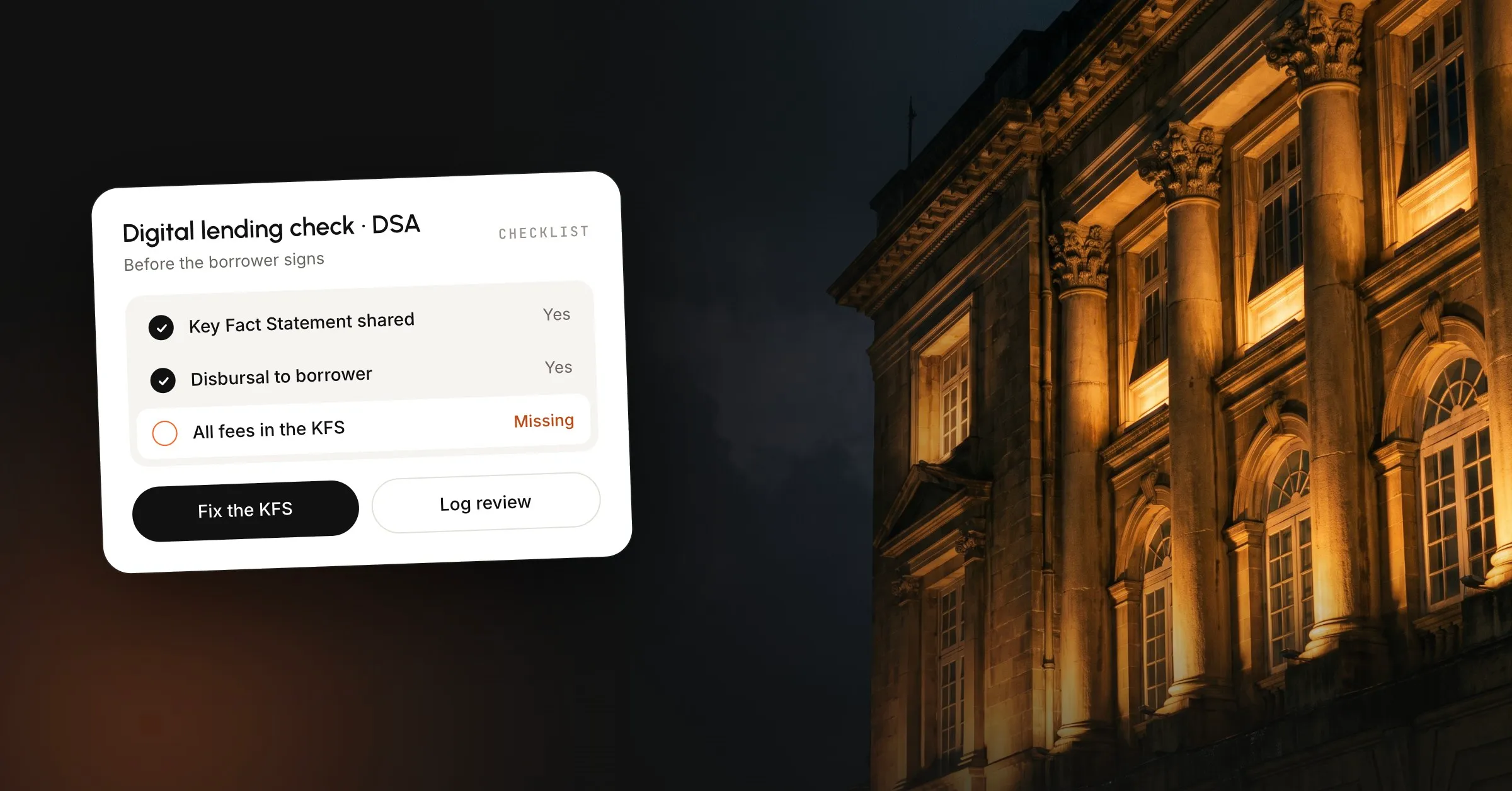
For retail and MSME term loans sanctioned on or after 1 October 2024, including a fresh loan to an existing customer, the NBFC gives a Key Fact Statement before the contract, in the annexed format. Credit-card receivables sit outside that section. The statement is in a language the borrower understands, and someone explains it, and the file keeps an acknowledgement.
It carries a unique proposal number. Validity is at least three working days when the tenor is seven days or more, and one working day when it is shorter. If the borrower agrees inside that window, the NBFC is bound by the statement. The annual percentage rate uses the net disbursed amount and includes the NBFC’s charges, with the amortisation schedule beside it. A fee left off the statement needs explicit consent before it can be charged. A processing fee kept on a cooling-off exit is disclosed here first.
The nodal grievance officer’s contact is on the statement and on the website. With no reply in 30 days, or an unhappy reply, the borrower can use the Reserve Bank’s Complaint Management System. We can remind someone the statement has not gone out. The document that goes out is the lender’s legal format, not a draft of ours.
KFS validity runs before the borrower agrees, and cooling-off runs after a digital loan is taken. During cooling-off the borrower can exit by paying the principal and the proportionate annual percentage rate, without a penalty. The NBFC sets that length in its credit policy, at a minimum of one day. Prepayment after the window follows the conduct directions as a separate rule. A branch file that was never digital does not inherit cooling-off because the sanction was typed on a laptop.
On execution of a digital loan, the digitally signed Key Fact Statement, the sanction letter and the terms go to the borrower’s registered email or SMS. The directions point that signature at the Information Technology Act, 2000. The acknowledgement that the borrower understood the statement remains a record a person can show later.
The agreement, the stamp paper the state requires, the insurance the product asks for, and the repayment mandate are ops work, and any one of them can hold the UTR. The mandate, NACH or eNACH as the bank registers it, sits on the account the statement already showed. Match the account number before anyone marks the mandate done. A change to the sanctioned terms goes back to the person who sanctioned them.
Disbursement goes into the borrower’s bank account. The chapter names three departures: a payment a statute or another regulator requires to go elsewhere, money moving between lenders in a co-lending transaction, and a specific end use paid straight into the end-beneficiary’s account. A machinery supplier can be that end-beneficiary. The DSA’s account is outside those three, and so is any other LSP account. The LSP has no control of the flow, direct or indirect. Any fee the LSP earns is paid by the NBFC, and it is kept off a separate collection from the borrower.
Repayment runs from the borrower into the NBFC’s account, without a pass-through or pool account. The UTR, the amount, the account and the time stay on the file the day the money moves. A part-disbursal is a condition on the sanction, with a UTR for each part. Cash recovery of a delinquent loan is a later exception, handled outside origination.
Origination ends when the loan is on the servicing system, with the schedule, the first due date and, if the loan was digital, the cooling-off end date. Reporting the loan to a credit information company, and filing any lending app on the Reserve Bank’s CIMS portal, stays with the NBFC, and we do not file either.
Collection is a separate process. The conduct directions keep overdue-recovery calls out of the hours before 8:00 a.m. and after 7:00 p.m., and microfinance loans follow a rule of their own.
The two sketches below are types of file we map with a desk, with no named borrower and no result attached.
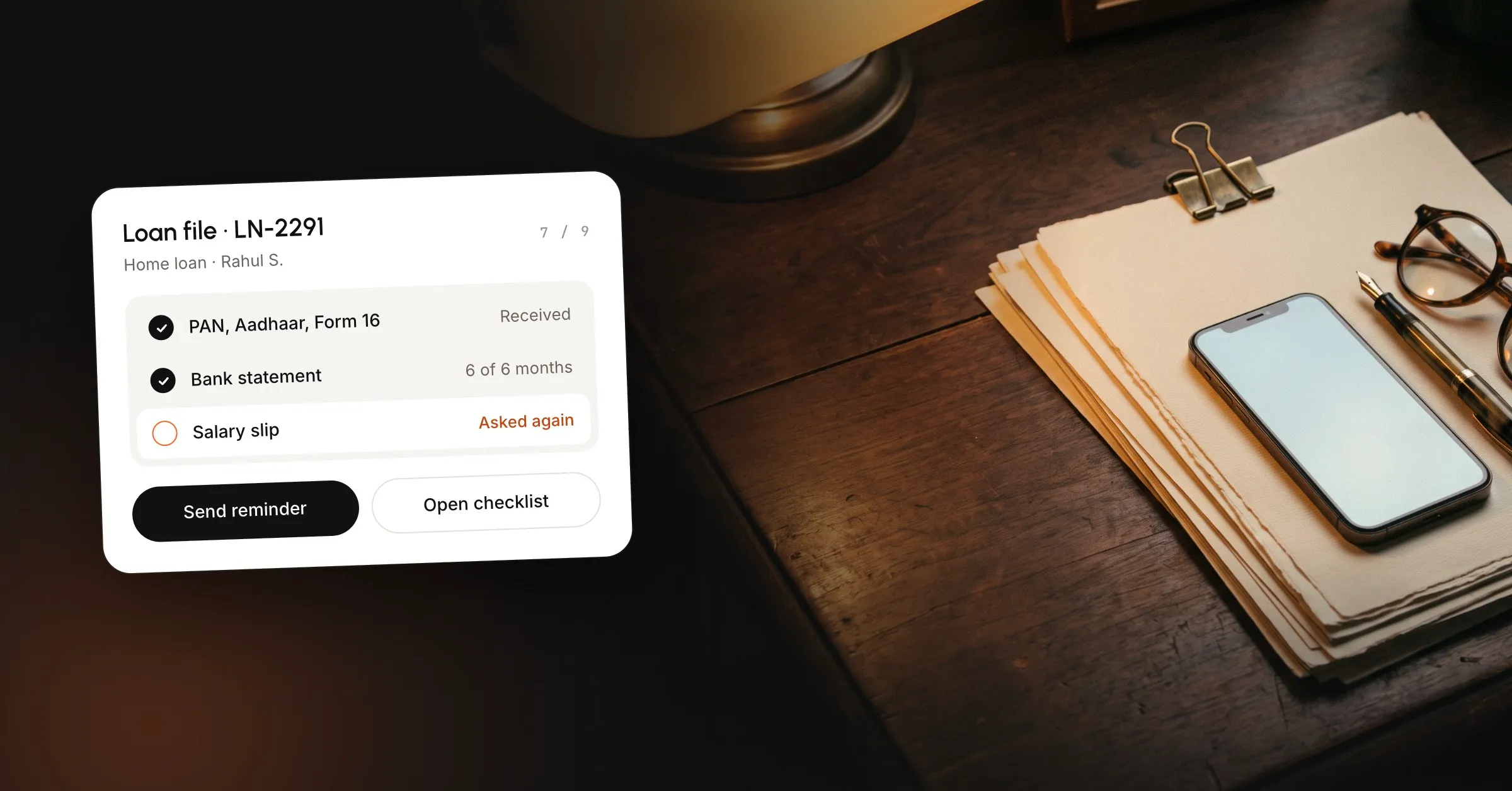
Sales logs amount, city and employer, and sends the salaried checklist. Consent for KYC and the bureau is stored before either pull. Slips, Form 16 and the salary account come in, and one missing slip is named once. Credit drafts the obligation ratio and the EMI already on the account, and the credit head sanctions or declines. The Key Fact Statement carries a proposal number, and a tenor of months gives the borrower at least three working days to agree. Ops registers the mandate on the salary account from the statement, and accounts releases the UTR to that account. Taken on the app, the loan starts a cooling-off of at least one day, and any fee kept on an early exit was already on the statement.
The connector code sits on the lead, and the relationship manager still owns the partner. Payout follows the client’s grid. KYC covers the proprietor and the firm on separate rows, and income is the business set. Legal opens title, encumbrance and tax receipts, and technical opens valuation. A field visit happens when the policy asks. The memo shows GST turnover, bank credits after self-transfers, and the gap. Sanction lists what still blocks the UTR: the legal report, the valuation, insurance, the mortgage. A payment to a supplier for a stated end use can use the exception above. A payment into the DSA’s account is outside that exception, and each part has its own UTR.
The chase and the first draft of the memo can run on the lender’s own number and folder. The credit decision, the legal opinion and the rejection stay with the people who already had that authority. A flag stays on the file until one of them writes it, and the Key Fact Statement that goes out is the lender’s format.
If this is the sequence on your desk, see how we set it up for lending and finance. It runs on your WhatsApp Business number and your file store, and your team still signs the memo. It is one of the sales and operations systems we build on the tools a firm already has.
Loan origination is the path from a logged lead to disbursal. Loan processing is the middle, where documents are collected, identity is checked and the file is put into a shape credit can read. A finished checklist can still have nobody authorised to sanction it. On a small desk one officer often does both, and the file should still show which job they were doing.
Underwriting is the credit assessment inside origination, covering bureau, income, obligations, security and the lender's policy. Origination also covers the lead, the Key Fact Statement, the agreement, the mandate and the disbursal. A careful memo can sit in a file that never disburses, because a condition is open or the applicant left. The process is finished when the money has moved and the loan is on the servicing system.
US pages say loan origination fee for an upfront charge to make the loan. Indian NBFC files call that a processing fee, and it belongs in the Key Fact Statement with every other charge. The annual percentage rate uses the net amount after those charges. A fee missing from the statement cannot be taken later without the borrower's explicit consent. The board of that NBFC sets the figure.
There is no single NBFC timeline. A salaried personal loan with a complete file can be sanctioned the day the statement is read. A loan against property waits on title, valuation and sometimes a visit. The delay we see most often is a missing page nobody has named. Count the days from login to a file credit can open, and from sanction to the UTR, as two clocks.
US servicing often uses origination date for the day the loan was made. An Indian file needs the login date, the date the Key Fact Statement was given, the date the borrower agreed, the UTR date and, on a digital loan, the day cooling-off starts. Record each one. A single origination-date field hides which clock is running.
The Reserve Bank requires outcomes on a digital loan: a Key Fact Statement, explicit consent, disbursal to the borrower's account, and a record. It does not require a brand of software. A sheet plus the lender's WhatsApp thread can hold the record if someone keeps them current. Software helps when the sheet starts to drift. Buying it does not meet the directions on its own.
The RBI digital lending guidelines were withdrawn as a standalone book. NBFCs now cite Chapter III, and a DSA still cannot take the fee.
The documents required for a business loan are entity papers, KYC and the income set. A missing GST month stalls the file after the first send.
AI for MSME India pays back on Tally and WhatsApp desk jobs. Sensors and forecasts wait until the data exists. What to run first, and what not to buy.
Book a 30-minute call. We'll map the workflow costing you the most hours and tell you honestly whether AI can fix it.
Book a 30-min call