
Loan origination process steps, from lead to disbursal
The loan origination process an NBFC or DSA actually runs, from the lead to the borrower's account, with the RBI rule at each step.
The documents required for a business loan are entity papers, KYC and the income set. A missing GST month stalls the file after the first send.

Nimish Gahlot
Founder, Empulse Labs
· Updated · 16 min read
Published
Updated · 16 min read
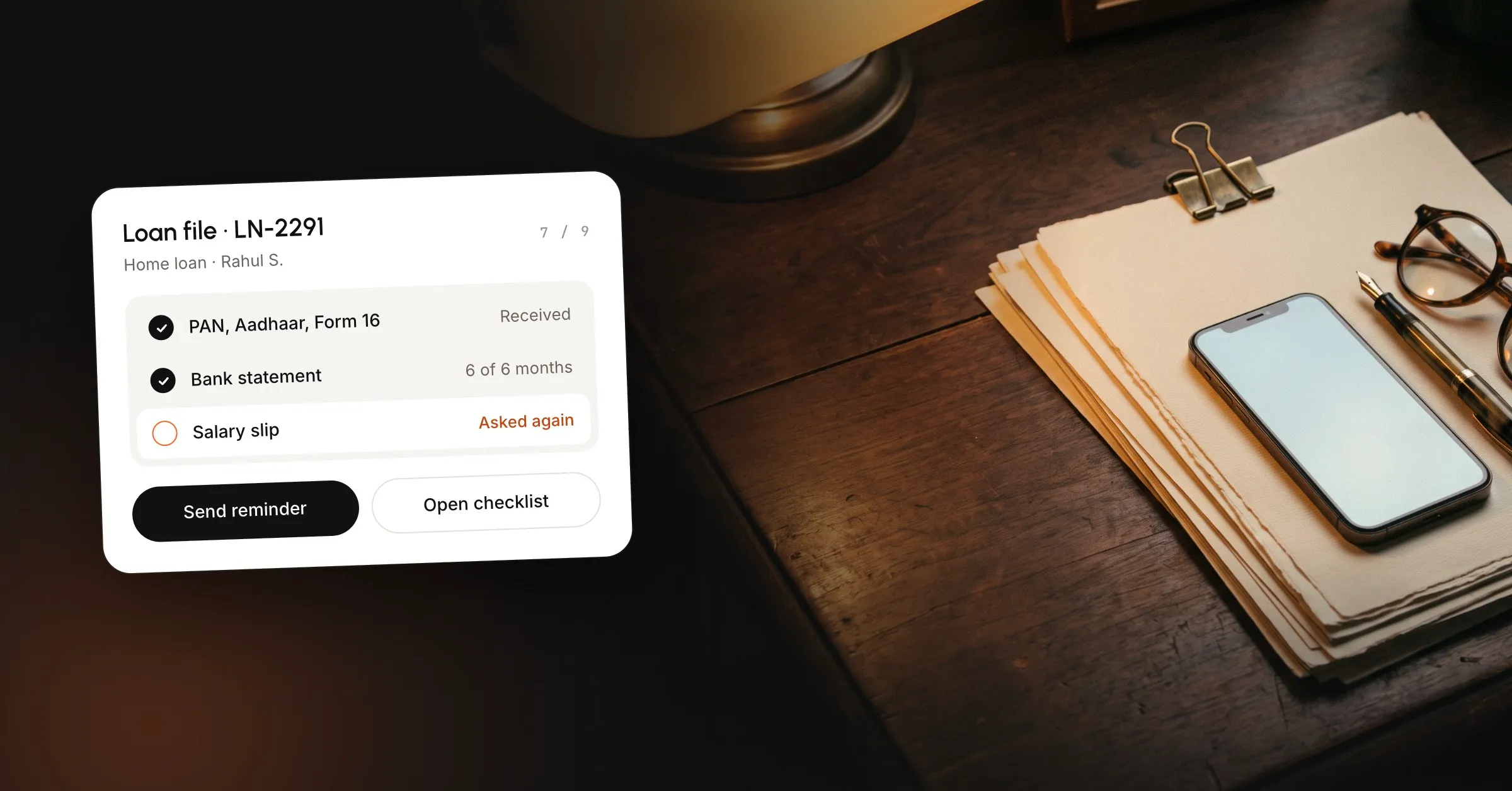
The documents required for a business loan are the entity papers, the KYC, and the income set: income-tax returns with the computation, GST returns where the firm is registered, bank statements, and the profit and loss with the balance sheet. Lenders differ on how many years they want. When a month is missing, the file stays open. The stall we keep seeing is the second message, the one that says “pending documents” after the applicant has already sent what they had.
Write the list once, in words an applicant can act on, and send that list. Bank checklists call themselves indicative, and the lender may ask for more. Put those extra rows on the product before the first message, so they do not arrive as a surprise on day four.
Every business-loan file starts with five groups. Put the years and the months on the list, because they are what the product actually asks for.
Collateral, a project report and projections are product rows. An unsecured term loan has no title search. Working capital usually needs next year’s figures, signed by the borrower. A machinery term loan needs the supplier, the price and the means of finance.
The income set looks much the same across constitutions, and the entity papers change with the constitution. Mixing the two is how a partnership deed lands in a proprietor’s thread, and how a company file reaches credit without a board resolution.
| Document | Proprietor | Partnership or LLP | Company | Received only if |
|---|---|---|---|---|
| PAN | Applicant and firm, if the firm has one | Firm PAN, plus each partner who signs | Company PAN, plus each signing director | The name matches the application |
| Officially valid document | The proprietor | Each partner the lender is binding | Each director who signs or guarantees | Photo and address are readable, not cropped |
| Entity paper | Declaration, shop licence or GST certificate | Deed or LLP agreement, registered if the policy says so | Certificate of incorporation, MOA, AOA, board resolution | The version is current and signed where required |
| ITR and computation | The years the product names | Firm, and often the partners | The company | The acknowledgement year matches the computation |
| GST returns | GSTR-1 and GSTR-3B if registered | Same, for the firm | Same, for the company | The months are continuous, from the GST portal |
| Bank statements | All operative accounts, 6 or 12 months | Current account, not only a partner’s savings | All operative accounts, including cash credit | Every page is there, including the last month |
| Financials | CA set, or the ITR set if policy allows | Audited or CA-certified, as policy says | Audited set, with schedules | Provisional is marked provisional |
| Existing loans | Sanction letters, if any | Same | Same, plus group facilities the policy includes | Limit and outstanding match what was declared |
Two checks sit outside that grid and still belong on the list. For statutory dues, record that GST, TDS and PF, where they apply, are being paid, and attach the returns rather than a sentence. For group exposure, ask for associate accounts and their last financials once the proposal is large enough that the lender’s policy asks. A consortium note belongs on a company file with three bankers, and a small proprietor file has nothing to put on that row.
Udyam shows up on MSME scheme lists. Download the returns from the GST portal and the Income Tax e-filing portal, because a photo of a summary is a weaker document than the file those sites give.
People also search for the documents required for a business loan in the UAE. We have not read a Central Bank of the UAE page, so this is not a regulatory claim. The desk pattern we would want confirmed is the same shape: papers on the lender’s own WhatsApp number, a person on the credit call, and that lender’s list in place of Form 16 and GST. Emirates ID, a visa page, a salary certificate and a liability letter are the nouns we hear, and we are not prepared to publish that set as a complete checklist.
The same desk often logs a home loan in the morning and a business file after lunch. When both products sit on one mental list, Form 16 gets demanded from a proprietor and a title paper gets left off a salaried file.
A salaried home loan needs PAN, an officially valid document, photos and a signed application. Income is the latest salary slips (three is the number most bank lists use), Form 16, and six months of the salary account with the credit visible. If the job is under a year old, ask for the appointment letter in the first message. Property papers follow the deal: allotment letter and receipts for a new flat, the chain of title and the agreement for a resale, approved plans and an estimate for construction.
A self-employed home loan uses the business income set: ITRs, computation, financials, bank statements, and proof the business exists. Loan against property adds the legal and technical set on top of whichever income list fits. Title search, encumbrance, tax receipts and the valuation are a second checklist, owned by legal and the valuer. Name it that way, so sales does not tell the applicant the file is done while legal has not started.
Title, deviations and the credit decision stay with people. A readable sale deed still needs a person on the chain of title, and the file can show that the scan is complete and legible.
A wholesale trading firm’s current account and a manufacturing firm’s GST return are different income. The loan file has to agree with the books that business already keeps, and those books remain the record of the business.
A stalled file is a missing page that nobody has named, and on a busy desk that file sits in the same tray as a decline.
A loan agency in Navi Mumbai was chasing every applicant three or four times on WhatsApp for missing pages, while one broker partner sent 600 leads. We are mapping that DSA process so the checklist and the checks run before a person opens the file. Legal title work stays with their experts, and results are not in yet. One ask per missing document is the target of that mapping.
A home loan, a loan against property and a self-employed GST file each need their own papers. When the list lives in a sales manager’s memory, the first message is “please share your documents”, and the second message, once someone remembers Form 16 or the sixth statement, is the list the product actually uses. Write that list down once per product.
Someone checks the salary slip on Monday. The missing September page turns up on Thursday, often with someone else, often after the applicant has asked for an update. Each pass finds one gap and sends one message, and that rhythm produces three or four follow-ups. Match the list in one pass and send every gap the same day.
“Please send pending documents” gives the applicant nothing to do, so they resend the whole PDF, send the wrong month, or wait. “Page 6 of the statement, September” is a request they can finish. If two things are open, name both. Anyone on the desk should be able to see later what was asked and what came back.
Applicants already send papers on WhatsApp, to a person. Change the reply so it names the gap, and update the file when the page arrives. Keep the thread on the lender’s own WhatsApp Business number, because a handset that leaves with a salesperson takes the chat with it. Meta’s WhatsApp Business Platform is the business account the loan file sits on.
A statement that claims six months and stops in August counts as five of six, with September open. Send a blurry salary slip back for a retake. A PAN whose name does not match the application waits for a person to check it before anyone declines the file.
Say it in one message: “The current-account PDF stops in August, on page 5 of 6. Please send September. GSTR-3B for those same months is still open. PAN, the deed and the ITR acknowledgement we asked for are in.” The applicant can see which page to send, and the next person on the desk can see what is in and what is still open.
Partner batches use the same view. Tag the source, and show where the file sits: logged, documents complete, with credit, sanctioned, disbursed. The relationship with that partner stays with the relationship manager, and the commission rules stay the client’s.
The statement is the document credit actually reads. Total credits fold in self-transfers, a loan received, and a one-off sale of an asset, so that total is a poor figure for income. A salaried account and a current account need different reads.
On a salaried file, the credit should show up every month, next to the salary slip and Form 16, from a name that holds for the whole period. Treat a one-month spike as something to ask the applicant about. On a business file, income is the customers who pay more than once. Take credits from the proprietor’s own savings account out before anyone totals turnover, and keep a loan disbursement out of sales. Write that exclusion list once, so two officers treat the same self-transfer the same way.
Obligations already leaving the account matter as much as the credits. Other EMIs, card payments and daily fintech debits often show up here when a bureau report is thin. Count inward returns, NACH or EMI returns, and minimum-balance charges. Record one return as a note with a reason. A run of returns waits for a person, and the file stays open while they look.
A month missing from the statement is a document the file still needs. Average bank balance, where the policy uses it, is the average of daily closings over the months you actually have, or the average of the dates the policy names. Some lenders use a few fixed days in the month. Name the method, and leave the missing month as a hole in the average.
GSTR-1 outward supplies, the turnover in the computation of income, and credits in the current account after self-transfers rarely match on the first pass. The memo shows all three numbers and the gap, and the draft keeps each figure. A person decides whether that gap is cash sales, another account not yet in the file, or timing.
Download the GST returns and the ITR for the same months as the statement, because a screenshot of a dashboard is a weaker file than the download. If the lender is already on the Account Aggregator rail, the statement can arrive as consented financial information. The Account Aggregator Directions, 2016 require the customer’s explicit consent, and that financial information does not stay with the aggregator. Most DSA files are still a PDF in a chat. Describe a consent flow only where the firm has switched it on.
The lender’s policy sets the expense factor, the same way on every file, before deposits are called eligible income. The officer can override it in the open, with a reason. Odd edits, a running balance that does not tie, or a salary credit that looks pasted go on the file as a flag, with the page attached. A person checks with the employer, the GST portal or the bank when the policy says to.
The work credit was hired for starts once the file is complete enough to assess. A complete PDF brings the file to that point, and the credit appraisal memo is the assessment, drafted so two readers see the same facts.
RBI has not prescribed a form for the memo, so each lender’s credit policy supplies one. A one-page draft that a small NBFC or a DSA’s credit head can sign tends to carry these sections.
The credit manager edits the draft, and two officers who started from the same notes can still disagree on it. The approval, the sanction or the rejection carries a person’s name, and any rejection waits until that person has written it.
A cleaner chase moves files to a decision, including the weak ones. Leave approval rate, sanction rate and disbursal rate out of the test, because those rates move when policy and the book move.
As of October 2026, the Reserve Bank of India (Digital Lending) Directions, 2025 leave the regulated entity responsible for the lending service providers it uses. A firm that sends borrower messages or holds borrower data for a bank or NBFC sits in that arrangement, and the lender remains the principal. Data collection is need-based, with explicit consent and an audit trail. The directions tell lenders to keep digital lending apps off phone contacts, call logs, media and telephony. Biometric data stays unstored unless a statute allows it. Data is stored on servers in India, and data processed outside India is deleted abroad and brought back within 24 hours. Where the client’s files live is a design choice for that lender.
Those directions point lenders to the Key Facts Statement circular of 15 April 2024. For retail and MSME term loans, the lender gives a KFS in the prescribed format before the contract, including the annual percentage rate, and takes an acknowledgement. We can remind a person that it has not gone out, and the KFS stays in the lender’s own format.
The Digital Personal Data Protection Act, 2023 is the borrower’s data law beside those directions. Notice and consent stay in the client’s text, the purpose of the collection stays limited to the loan, and withdrawal has to be as easy as the consent was. We do not train public models on applicant files, and we do not give legal advice on whether a given NBFC is a significant data fiduciary.
Keep recovery off this document thread. The RBI circular of 12 August 2022 tells NBFCs, including housing finance companies, to stay away from calls before 8:00 a.m. or after 7:00 p.m. for overdue recovery, and away from harassment. A document chase on an application is a different job from recovery, so threats, messages to family, and contact outside the lender’s hours stay off the chase. Microfinance loans sit under other directions, and this post does not advise on those.
Measure the chase on one product for a month.
Count follow-ups per file, meaning messages that ask for something. If the desk was at three or four typed chases and the missing page is now named once, this is the count that should move. If it stays put, the list is wrong or the message is still vague.
Track the share of files that reach credit with the checklist done. Agree what done means first: which months, which KYC, which property papers, and which items legal still clears by hand. A file that moves faster while two months are still missing has not cleared the stall.
Record the time from the first WhatsApp to a file a credit manager can open. If that interval drops along with the follow-up count, the second message is closing a named gap.
Pick one loan type and write the checklist in words an applicant would understand. Run it on your own number, and keep every decline with the team. Add the statement read, then the memo, once that chase is reliable.
Document collection is one stage of a longer file. Every step from the first enquiry to disbursal is in the loan origination process, and the rules that bind each step are in RBI digital lending guidelines for NBFCs and DSAs.
If this is the stall on your desk, see how we set it up for lending and finance. It runs on your WhatsApp Business number and your own file store, and your team still signs the memo. It is one of the sales and operations systems we build on the tools a firm already has.
Most lenders that tag a proposal as MSME ask for the Udyam certificate, and several public-sector checklists treat it as part of that scheme. PAN, GST returns and bank statements stay on the file either way. A firm without Udyam can still be a business-loan file on a product outside the MSME schemes. Check that lender's credit policy before calling the certificate compulsory for every business loan.
A balance transfer needs the existing sanction letter or agreement, the outstanding, the repayment record, fresh KYC, recent ITRs, financials and bank statements. A secured file also needs the title set the current lender holds, or a list of those originals. The new lender reassesses the borrower and sets its own limit. Give the transfer pack its own checklist, or the file stalls on the foreclosure letter.
Many business-loan lists ask for two or three years of returns with the computation of income. A few small-ticket programmes accept a thinner set. Whether one year is enough depends on that product's rule. If the credit policy on that product wants three years, leave income open on a single acknowledgement and name the missing years in the same message as any other gap.
Guarantors and co-applicants submit their own KYC. Where the lender takes a personal guarantee, they often also submit an ITR or a net-worth certificate. The firm's GST returns stay filed under the firm's name. If the proprietor sent a PAN and the guarantor's officially valid document is missing, that guarantor's KYC is still open. Put each person on the checklist as a separate row.
The bureau pull, where the lender is allowed to make it, is the lender's report, taken with the applicant's consent. Record that consent was taken and that the report is on the file. Ask for the applicant's own printout only when policy wants it, rather than asking them to photograph a PDF every time. Loans that never reached a bureau still show up as debits on the statement.
How long a lender keeps documents after a decline is its own rule, under its policy and the laws that apply, including the Digital Personal Data Protection Act, 2023 where it is the data fiduciary. We do not set a number of years, and we do not give legal advice. Record the decline date, who can open the folder, and the day the client's rule says the copies go.
The loan origination process an NBFC or DSA actually runs, from the lead to the borrower's account, with the RBI rule at each step.
The RBI digital lending guidelines were withdrawn as a standalone book. NBFCs now cite Chapter III, and a DSA still cannot take the fee.
AI for MSME India pays back on Tally and WhatsApp desk jobs. Sensors and forecasts wait until the data exists. What to run first, and what not to buy.
Book a 30-minute call. We'll map the workflow costing you the most hours and tell you honestly whether AI can fix it.
Book a 30-min call